


Introduction
If you followed Week 1, you built the Strategic Foundation Framework. If you already had a strong strategic foundation in place, you skipped Week 1 entirely and that’s fine as not every organization needs to start from scratch.
Now comes the question: are you ready for transformation?
Most companies assume they’re more ready than they are. Leadership believes everyone’s aligned, executives think strategy cascades properly, people claim governance exists. Then they launch AI initiatives and reality hits… nobody knows what they’re accountable for, departments optimize for conflicting goals, and transformation dies in the chaos.
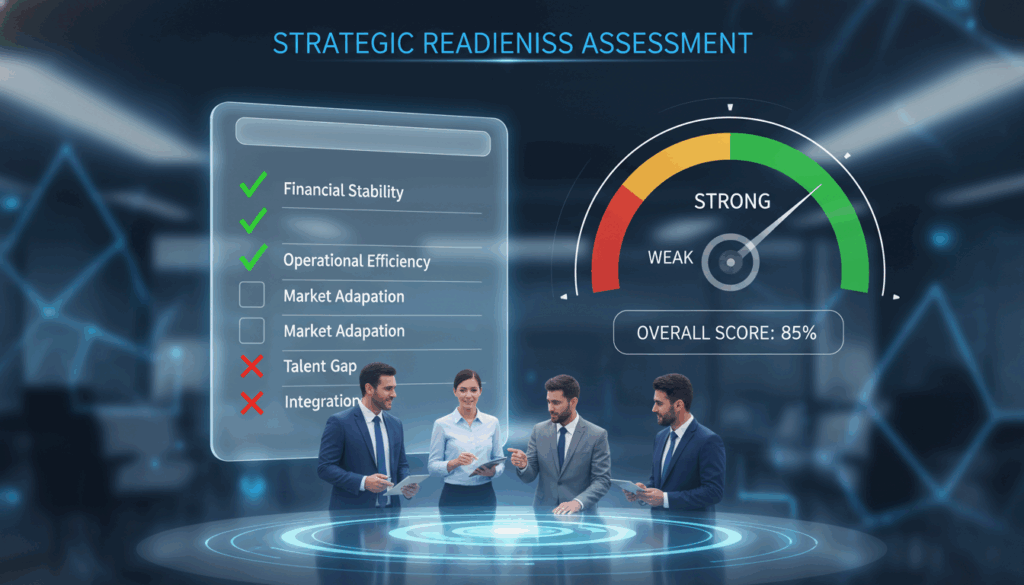
Week 2 assesses your strategic readiness before you invest in transformation. Not aspirational readiness, not “we’re working on it” readiness but actual, measurable, data-backed readiness.
This diagnostic reveals whether your foundation can support transformation or if you need to fix fundamentals first.
Why This Diagnostic Exists
Research shows that 90% of organizations fail to execute their strategies successfully. Not because strategies are bad, but because organizations aren’t ready to execute them.
The pattern I’ve seen for 15 years: companies create beautiful strategic plans, present them to boards, get approval, allocate budget, then watch everything collapse during execution. Why? Because they never assessed if the organization could actually execute.
Some organizations built foundation years ago and maintain it well and others just completed Week 1. Many assume they have foundation but never verified it. This diagnostic works for all three scenarios. It reveals the truth about strategic readiness regardless of how long you’ve had strategy in place.
The five failure points:
Strategy exists but nobody can articulate it. Ask three C-suite executives to explain the strategy. Get three different answers. Ask department heads, get blank stares. Strategy documents exist, but strategic clarity doesn’t.
Departments have goals but they’re not connected to corporate strategy. Marketing optimizes for leads, sales complains, leads are garbage, operations promises delivery dates and sales can’t keep up. Everyone’s working hard, nobody’s aligned. KPIs exist at every level but don’t connect.
People have objectives but can’t trace them to corporate goals. Employees work on initiatives that sounded important six months ago. Nobody knows if those initiatives still matter and can’t explain how their work contributes to company success. The line of sight from CEO to frontline doesn’t exist.
Governance exists on paper but not in practice. Monthly strategic reviews where nothing gets decided. Quarterly board meetings where everyone nods. PMO tracks metrics nobody uses to make decisions. Governance theater without governance reality.
Strategy is secret knowledge leadership possesses. Executives know the strategy… maybe. Department heads heard about it once, frontline employees have no idea. When people don’t know where the company’s going, they can’t help get there.
This diagnostic measures all five and then tells you exactly where to focus before attempting transformation.
How The Diagnostic Works
Five dimensions. Ten points each. Fifty points total. One clear answer on strategic readiness.
Each dimension has specific questions that force honest answers. Not “are we working on this?” but “can we prove this exists with data?”
Note on Week 1 overlap: Yes, some of this repeats concepts from Week 1. That’s intentional. Week 1 builds the foundation and week 2 measures if you actually built it properly. Repetition isn’t redundancy, it’s verification that implementation happened.
Dimension 1: Strategy Clarity
The Question: Can your C-suite articulate the same strategy?
Why It Matters: Companies with a well-defined strategy achieve a 5.2% higher annual revenue growth rate than those without one. But “well-defined” means executives actually agree on what the strategy is and most don’t.
How To Assess:
Interview each C-suite executive individually. Don’t let them prepare, don’t give them the strategic plan just ask five questions:
-
- What’s our strategy in two sentences
- What are our strategic priorities for the next three years?
- What are we explicitly not doing?
- What does success look like in three years?
- How does our strategy differ from competitors?
Scoring:
-
- 0-2 points: Executives give completely different answers. No consistent strategy exists.
-
- 3-5 points: Executives mention similar themes but can’t articulate specifics consistently.
-
- 6-8 points: Executives align on vision and priorities but differ on details and trade-offs.
-
- 9-10 points: Executives give near-identical answers with consistent language and specific details.
What Good Looks Like:
Your CFO, COO, and CTO interviewed separately and they all say: “We’re achieving 12% operating margin by 2026 through three pillars: operational excellence reducing cost per order from $47 to $35, growth expanding into commercial segments for 25% revenue increase, and talent retention maintaining 90%+ retention of top performers. We’re explicitly not pursuing consumer segments or international expansion during this period.”
That’s 9-10 points. Anything less means strategy clarity is broken.
If You Score Low:
If you didn’t need Week 1 because you already had foundation, revisit your Future Vision Workshop process. Your C-suite alignment has drifted. If you followed Week 1, go back to that component. Either way, fix alignment before proceeding.
Dimension 2: Business Alignment
The Question: Do departments have KPIs tied to corporate strategy?
Why It Matters: Strategy doesn’t execute itself, departments execute strategy. If department KPIs don’t connect to corporate goals, departments optimize locally while destroying value globally.
How To Assess:
Pull the KPI dashboards from five departments. For each department KPI, trace the connection to corporate strategic goals. Can you draw a clear line from “cost per order” (department KPI) to “operating margin” (corporate goal)? Or do department KPIs exist in isolation?
The Test:
Map every department KPI to strategic pillars from Week 1. If a department KPI doesn’t support a strategic pillar, it’s either wrong or the pillar definition is incomplete.
Scoring:
-
- 0-2 points: Departments have KPIs but they’re not connected to corporate strategy. Can’t trace relationship.
-
- 3-5 points: Some departments have aligned KPIs. Others measure what’s easy instead of what matters.
-
- 6-8 points: Most departments have KPIs tied to strategy but gaps exist. Some KPIs misaligned.
-
- 9-10 points: Every department KPI directly supports a strategic pillar. No orphan metrics.
What Good Looks Like:
Operations department has “cost per order” KPI directly supporting “operational excellence” pillar which feeds “12% operating margin” corporate goal. Customer Success has “retention rate” KPI supporting “growth” pillar which feeds “25% revenue increase” corporate goal. Every department metric connects clearly.
If You Score Low:
If you need to build or rebuild KPI cascading: Either revisit Week 1’s KPI Cascading component if you followed it, or implement a similar process to connect department goals to corporate strategy. Department goals floating independently means strategy won’t execute.
Dimension 3: Ownership & Accountability
The Question: Can you trace corporate goals to individual owners?
Why It Matters: Organizations can only transform at the pace of their executives’ transformation. But transformation requires individual accountability. If nobody owns specific outcomes, nobody delivers them.
How To Assess:
Pick three corporate KPIs. For each one, trace backwards:
-
- Corporate KPI → Which pillar?
-
- Pillar → Which pillar owner?
-
- Pillar owner → Which department heads?
-
- Department heads → Which team leads?
-
- Team leads → Which individuals?
Can you name actual people at every level? Or does ownership disappear somewhere in the organization?
The Traceability Test:
Start with “12% operating margin by 2026.” Can you trace that to:
-
- CFO (pillar owner for operational excellence)
-
- VP Operations (department head)
-
- Process Improvement Manager (team lead)
-
- John Smith, Process Analyst (individual contributor working on order automation)
If you can’t name real people at every level, accountability doesn’t exist.
Scoring:
-
- 0-2 points: Corporate goals have no clear owners. Shared accountability means no accountability.
-
- 3-5 points: Pillar owners exist but ownership dilutes at department level. Can’t trace to individuals.
-
- 6-8 points: Can trace most corporate goals to department level. Some gaps at team/individual level.
-
- 9-10 points: Complete traceability from corporate KPI to individual contributor. Everyone knows their role.
What Good Looks Like:
You pick “operating margin” corporate goal. You immediately identify: CFO owns it, VP Operations drives cost reduction, Process Improvement Manager leads automation, three process analysts each own specific automation initiatives that collectively deliver the $12 cost reduction needed. You can name every person and their specific deliverable.
If You Score Low:
You need to assign clear ownership at every level. If you followed Week 1, revisit the KPI Cascading and Strategic Pillars components to assign owners. If not, implement an ownership framework that traces every corporate goal to named individuals. Strategy without owners doesn’t execute.
Dimension 4: Governance Maturity
The Question: Does your PMO track and report with real data?
Why It Matters: Governance isn’t an optional ceremony, it’s how strategy survives contact with reality. Without governance tracking progress with real data, you’re flying blind. By the time you realize you’re off track, it’s too late to correct.
How To Assess:
Attend your monthly strategic review meeting. (You do have monthly strategic reviews, right?) Evaluate:
-
- Do pillar owners report actual data or anecdotes?
-
- Are KPIs measured with numbers or vibes?
-
- When someone says “we’re on track,” can they prove it?
-
- When problems emerge, are they visible early or late?
-
- Do decisions get made or deferred?
The Governance Reality Check:
Review last quarter’s strategic review meetings. Count how many times decisions were made based on data versus how many times they were made based on executive intuition or postponed entirely.
Scoring:
-
- 0-2 points: No regular strategic reviews. Or meetings happen but nothing gets measured or decided.
-
- 3-5 points: Meetings exist. People present slides. No real data. Decisions get deferred indefinitely.
-
- 6-8 points: Regular meetings with some data. Decisions sometimes made. Tracking inconsistent.
-
- 9-10 points: Weekly/monthly/quarterly cadence established. Real data reviewed. Decisions made rapidly. Problems caught early.
What Good Looks Like:
Your monthly strategic review: Each pillar owner presents current KPI performance against targets with actual numbers. CFO reports operating margin currently at 10.2% (target: 10.5% by month end), trending behind due to supplier price increase. Team proposes solution, CFO approves $50K to qualify alternate supplier, decision made in meeting, action assigned, next review scheduled. That’s governance.
If You Score Low:
You need to build real governance, not governance theater. If you followed Week 1, go back to the Communication & Governance component and actually implement it. If not, establish weekly operational reviews, monthly strategic reviews, and quarterly board reviews with real data and actual decisions. Build the meeting cadence and decision rights framework.
Dimension 5: Transparency
The Question: Do employees know the strategy and their role in it?
Why It Matters: Research shows that 85% of job success comes from having well-developed soft skills and people skills, and only 15% comes from technical skills. But even the best people skills can’t compensate for not knowing where the company’s going. When employees don’t understand strategy, they can’t align their work to it.
How To Assess:
Interview 10 random employees at different levels. Not managers, not people who attended strategic planning sessions. Frontline employees, mid-level individual contributors, people who do the actual work.
Ask three questions:
-
- What’s our company strategy
- What are you personally accountable for
- How does your work contribute to company success?
Scoring:
-
- 0-2 points: Employees have no idea about strategy. Can’t explain how their work connects to company goals.
-
- 3-5 points: Employees heard about strategy once. Remember nothing. Don’t know their role in it.
-
- 6-8 points: Employees can describe strategy generally but can’t connect their work to it specifically.
-
- 9-10 points: Employees articulate strategy, know their KPIs, explain how their work contributes to corporate goals.
What Good Looks Like:
You ask a process analyst: “What’s our strategy?” They say: “We’re driving to 12% operating margin by improving operational efficiency. My role is automating order entry to reduce cost per order. I’m currently implementing automation that should reduce processing time from 22 hours to 16 hours, which contributes to the $12 cost reduction target that feeds our margin goal.”
That’s 9-10 points. That’s what happens when strategy cascades properly and communication actually works.
If You Score Low:
Your communication rhythm doesn’t exist or isn’t working. Strategy is trapped at the executive level. If you followed Week 1, implement the Communication & Governance component properly. If not, establish regular communication after every strategic review: department heads to teams, CEO to all employees, visible progress tracking. Make strategy common knowledge, not secret executive information.
Calculate Your Strategic Readiness Score
Add up scores from all five dimensions. Maximum 50 points.
0-15 points: No Foundation
You don’t have a strategic foundation, you have strategic chaos. Don’t attempt AI transformation, don’t launch new initiatives and don’t invest in technology.
Go back to Week 1 and build the foundation properly. This will take time and it should take time. You’re building what should have existed years ago.
What this means: Your C-suite isn’t aligned, departments optimize for conflicting goals and nobody knows what they’re accountable for. Governance doesn’t exist and employees don’t know where the company’s going.
Reality check: You might have revenue and customers and products that work but you’re succeeding despite chaos, not because of strategy. That works until market conditions change, competitors move, or you try to scale, then chaos becomes fatal.
Next steps:
-
- Run Week 1: Future Vision Workshop to align C-suite
-
- Define strategic pillars with clear funding
-
- Cascade KPIs from corporate to individual
-
- Establish governance cadence
-
- Communicate strategy repeatedly
Timeline: 3-6 months to build a real foundation. Don’t rush this as rushing is why you’re at 0-15 in the first place.
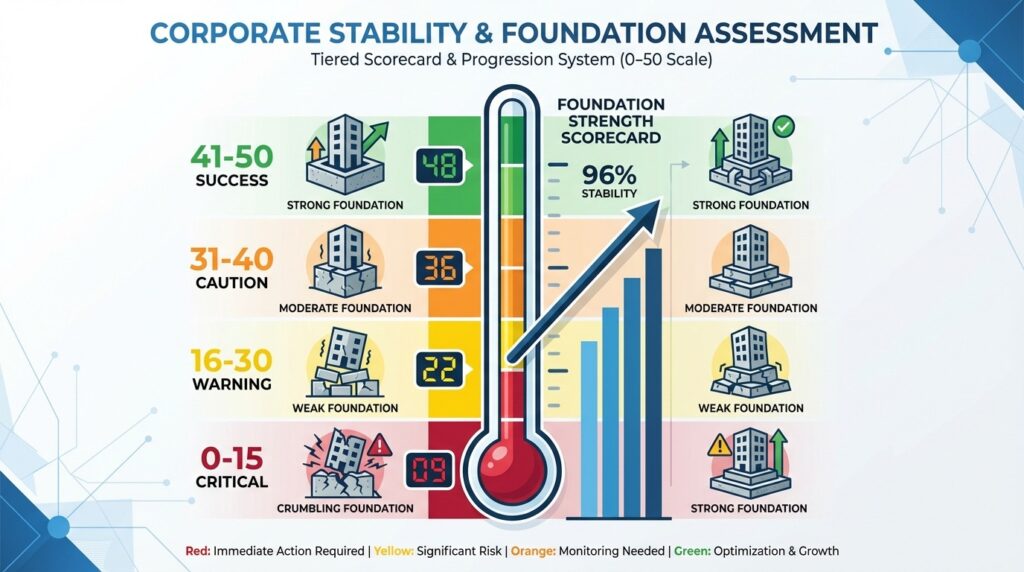
16-30 points: Weak Foundation
You have pieces of foundation but they’re not connected. Strategy exists but isn’t executed and some departments align but others don’t. Governance happens occasionally but not systematically.
You can attempt small-scale initiatives but don’t try company-wide transformation yet. You’ll fail for the same reasons 90% of companies fail due to a weak foundation that collapses under transformation pressure.
What this means: Leadership probably aligned on strategy but that alignment didn’t cascade. Or it cascaded to some departments but not others. Governance exists but doesn’t catch problems early and communication happens but doesn’t stick.
Reality check: You’re doing better than most companies but that’s not saying much. Most companies operate in chaos and you operate in partial chaos. Still not ready for transformation.
Next steps:
-
- Identify which dimensions scored lowest (probably Business Alignment, Ownership, or Transparency)
-
- Focus Week 1 work on those specific areas
-
- Don’t try to fix everything simultaneously
-
- Pick two dimensions to strengthen over next quarter
Timeline: 2-4 months to move from weak to moderate foundation.
31-40 points: Moderate Foundation
You have a working foundation, not perfect but functional. Strategy exists and cascades. Most departments align, governance catches some problems and employees know generally where the company’s going.
You can attempt transformation but expect friction. Your foundation will hold under pressure but you’ll discover gaps during execution. That’s okay as discovery during execution is better than failure during execution.
What this means: You did Week 1 work, mMaybe not perfectly, but you did it. C-suite is aligned, most departments have connected KPIs, some people can trace their work to corporate goals and governance happens regularly even if not perfectly.
Reality check: You’re in the top 25% of companies. Most organizations never reach a moderate foundation. You have enough structure to attempt transformation without catastrophic failure.
Next steps:
-
- Run transformation pilots in areas where foundation is strongest
-
- Use pilot learnings to strengthen weak areas
-
- Expect to iterate on governance and communication
-
- Don’t assume foundation is “done”—it requires ongoing maintenance
Timeline: Pilot transformations can start now. Continue strengthening the foundation in parallel.
41-50 points: Strong Foundation (Ready for AI)
You have a strong strategic foundation, c-suite aligned, departments connected, ownership clear, governance functioning, employees informed. You’re ready for transformation.
This doesn’t mean transformation will be easy. It means you won’t fail for preventable reasons. You won’t discover in six months that nobody knew the strategy, you won’t realize mid-implementation that ownership was unclear and you won’t hit governance gaps that prevent decision-making.
What this means: You did Week 1 properly. You verified it worked, you maintained it, your foundation will hold under transformation pressure.
Reality check: You’re in the top 10% of companies. Most never get here. This is the result of disciplined execution of basic strategic principles most companies ignore.
Next steps:
-
- Move to Week 3 and beyond
-
- Begin AI transformation planning
-
- Expect your foundation to be tested
-
- Plan to refine governance as you learn
Timeline: Ready for transformation now but don’t stop maintaining foundation. It’s not “done”, it’s working, keep it working.
The Deliverable: One-Page Strategic Readiness Scorecard
Your output from Week 2 is a single-page scorecard that documents:
Strategic Readiness Assessment
-
- Date assessed
-
- Assessed by
-
- Overall score (0-50)
Dimension Scores:
-
- Strategy Clarity: X/10
- Business Alignment: X/10
- Ownership & Accountability: X/10
- Governance Maturity: X/10
- Transparency: X/10
Readiness Level: [No Foundation / Weak Foundation / Moderate Foundation / Strong Foundation]
Key Findings:
-
- Top 3 strengths
-
- Top 3 gaps
-
- Critical risks if transformation attempted now
Recommended Next Steps:
-
- If 0-15: Return to Week 1, focus on [specific components]
-
- If 16-30: Strengthen [specific dimensions] over next quarter
-
- If 31-40: Proceed with pilots in strong areas, shore up weak areas
-
- If 41-50: Ready for transformation, proceed to Week 3
Timeline: [Your realistic timeline for readiness]
This scorecard goes to your board. It’s the honest answer to “are we ready for AI transformation?” Most companies skip this step, they assume readiness and then they fail predictably.
You’re not most companies, you assessed honestly and now you know where you stand.
The Healthcare Company: Their Week 2 Results
Remember the healthcare company from Week 1? After building their Strategic Foundation Framework, they ran this diagnostic.
Their Scores:
-
- Strategy Clarity: 8/10 – C-suite aligned after Vision Workshop. Minor differences in timing.
- Business Alignment: 6/10 – Most departments aligned. Operations strong, IT weak, Finance disconnected.
- Ownership & Accountability: 5/10 – Pillar owners clear. Department level is mostly clear. Individual level spotty.
- Governance Maturity: 7/10 – Meeting cadence established. Data is improving but not perfect.
- Transparency: 4/10 – Executives know strategy. Department heads know some. Frontline confused.
Total: 30/50 – Weak Foundation
This surprised leadership. They’d just spent five days building a foundation. How were they only at 30? Because building the framework and executing it properly are different things. Week 1 created the documents and Week 2 revealed the documents hadn’t cascaded to actual behavior yet.
What They Did:
Instead of proceeding to transformation, they spent 60 days strengthening weak areas:
-
- Business Alignment: Worked with IT and Finance to rebuild their KPIs connecting to strategic pillars
-
- Ownership & Accountability: Assigned individual owners for every initiative, not just departments
-
- Transparency: Implemented monthly all-hands where CEO explained strategy and progress with real numbers
Three months later, they reassessed: Score jumped to 38/50 – Moderate Foundation.
Not perfect but strong enough to proceed. They launched their AI implementation and it worked because the foundation held.
Companies that skip Week 2 diagnostic launch transformations on weak foundations. Foundation cracks, transformation fails, they blame AI, blame change resistance, blame market conditions.
The healthcare company blamed nothing. They assessed honestly, fixed gaps, then transformed successfully.
Common Patterns In Diagnostic Results
After running this diagnostic across industries for years, patterns emerge:
Pattern 1: High Strategy Clarity, Low Everything Else
Score: Strategy Clarity 9/10, others 3-5/10. Total: 20-30.
What happened: Leadership did great, vision Workshop, created a beautiful strategy and stopped there. Never cascaded it, never built governance and never communicated.
Why it happens: Creating strategy feels like accomplishment. Executing strategy feels like work. Leadership celebrates the strategy document, declares victory, moves on.
Fix: Go back to Week 1 components 3-5. You skipped the hard parts.
Pattern 2: High Governance, Low Transparency
Score: Governance 9/10, Transparency 2/10. Total: 30-35.
What happened: Executives built robust governance, PMO tracks everything, monthly reviews function well but none of this cascaded to broader organization. Governance is an executive club activity.
Why it happens: Executives focus on executive-level problems. Forget that strategy executes at all levels, not just the top.
Fix: Implement communication rhythm from Week 1. Stop treating strategy as secret knowledge.
Pattern 3: Everything Moderate
Score: All dimensions 6-7/10. Total: 30-35.
What happened: Organization did everything, nothing done deeply, spread effort across all areas without mastering any.
Why it happens: Trying to fix everything simultaneously or doing minimum viable effort everywhere instead of excellence anywhere.
Fix: Pick two dimensions. Get them to 9-10. Build excellence in critical areas before spreading thin.
Pattern 4: Uneven Distribution
Score: Two dimensions at 9-10, two at 2-3, one at 5. Total: 30-35.
What happened: The organization invested heavily in some areas while completely neglecting others.
Why it happens: Playing to strengths instead of addressing weaknesses or different executives owning different pieces without coordination.
Fix: Address the 2-3 scoring dimensions immediately. They’re your failure points. Strengths don’t compensate for fundamental gaps.
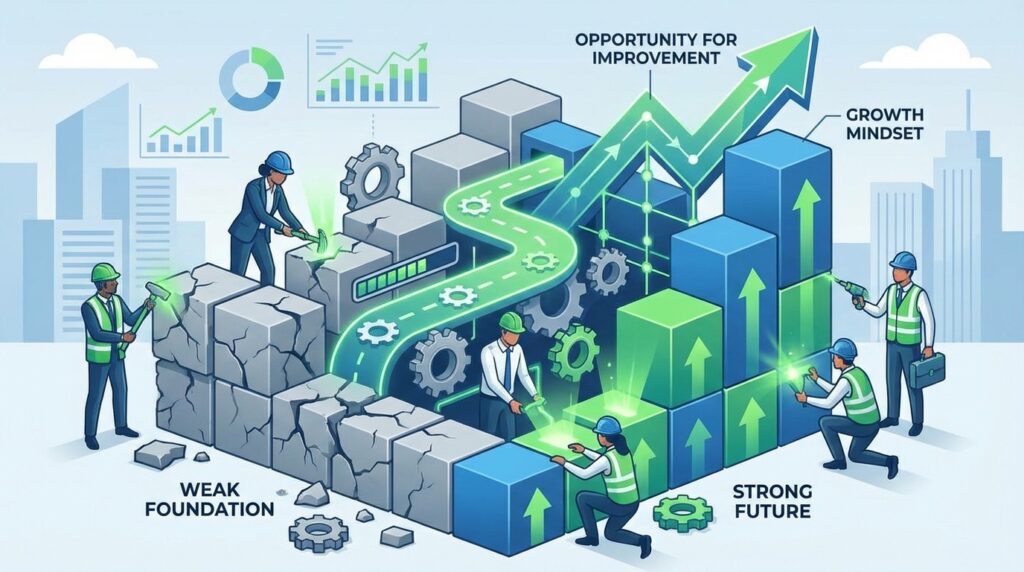
What If You Score Low?
Don’t panic, most organizations score low. That’s normal, you’re assessing honestly, which most companies never do.
Low scores don’t mean failure. They mean you now know what to fix and that’s progress.
If you scored 0-15:
You’re starting from scratch or your foundation has completely eroded. That’s okay, better to know now than discover during a failed transformation.
You need to build (or rebuild) a strategic foundation. Don’t rush it, this takes months and it should take months. You’re building what should exist but doesn’t.
If you followed Week 1 but still scored this low, something went wrong, either implementation was superficial or organizational resistance prevented adoption. If you didn’t follow Week 1, these are the components you need to build:
Focus sequence:
-
- Future Vision Workshop (get C-suite aligned)
- Strategic Pillars (define priorities, kill initiatives)
- KPI Cascading (connect strategy to work)
- Governance (build decision-making structure)
- Communication (make strategy visible)
Don’t skip steps, don’t do them simultaneously. Sequential execution builds a stable foundation.
If you scored 16-30:
You have pieces but they’re not connected. Focus on connections.
Identify your lowest-scoring dimension, that’s your constraint. Fix that before improving higher-scoring areas.
If Business Alignment is lowest: Rebuild department KPIs to connect to strategic pillars. If Ownership is lowest: Assign individual owners to every initiative and KPI. If Transparency is lowest: Implement communication rhythm so strategy cascades.
Timeline: Quarter to move from weak to moderate. Two quarters to move from weak to strong.
If you scored 31-40:
You can proceed but expect friction. Your foundation will hold but you’ll discover gaps.
Run small pilots first. Learn where foundation is weak under real transformation pressure. Strengthen those areas and then scale.
Don’t assume moderate foundation is sufficient, It’s minimum viable. Strengthen it in parallel with transformation.
If you scored 41-50:
Proceed to transformation. But stay vigilant.
Strong foundation doesn’t mean perfect foundation. Transformation will test it and some areas will crack, that’s expected.
Build feedback loops. When something breaks, fix the foundation, don’t bypass it. Companies with strong foundations fail when they stop maintaining it under transformation pressure.
Moving Forward
Week 2 diagnostic answered the critical question: are you ready for transformation?
If yes: Proceed to Week 3.
If no: Build or rebuild foundation. Fix what’s broken, reassess, then proceed.
The goal isn’t a perfect score. The goal is honest assessment before investing in transformation.
Most companies skip this assessment, assume readiness, and fail during transformation. You assessed honestly. That’s the difference between companies that transform successfully and companies that waste money on pilots that never scale.
Next week: We’ll cover how to sequence AI initiatives so they actually deliver value instead of becoming expensive science projects.
For now, run the diagnostic, get your score, know where you stand.
Download: Strategic Readiness Scorecard Template
Get the one-page scorecard template below to document your assessment, track scores, and present findings to leadership.
Week 2: The Strategic Foundation Diagnostic
Part of the Strategic Foundation Framework by EQ-AI Bridge Advisory LLC
Next: Week 3 – AI Initiative Sequencing (Coming Next Week) Previous: Week 1 – Building Corporate Strategy When None Exists


