


Introduction
You’ve built strategic foundation, integrated AI, customized execution, and prepared your workforce. Now comes the final piece most companies get catastrophically wrong: governance.
Without governance, everything you’ve built falls apart during execution. AI initiatives drift from strategy, decisions don’t get made, blockers don’t get resolved, nobody knows who’s accountable when things go wrong, and six months later you discover AI delivered 30% of projected value because there was no structure ensuring execution happened.
Research shows organizations with strong AI governance are 2.5 times more likely to achieve their AI transformation goals compared to those without governance. Yet most companies treat governance as bureaucratic overhead rather than what it actually is: the operating system that ensures transformation delivers promised business value.
Week 6 introduces the AI Governance Operating Model, the structure, process, and metrics that turn strategy and planning into actual results.
Note on overlap with previous weeks: Yes, this builds on governance concepts from Week 1 and Week 3. That’s intentional, we established what governance should exist, now we’re defining exactly how it operates in practice with roles, cadences, decision rights, and metrics.
Template Package Available: This framework comes with ready to use templates. Templates are available for download at the bottom of this blog.

The Problem: Governance as Theatre, Not Reality
Here’s the pattern: Companies create governance structures on paper, they define a steering committee with impressive executive names, establish a PMO that’s supposed to track everything, set up working groups for execution, then launch AI initiatives and discover the governance doesn’t actually govern.
The steering committee meets quarterly, reviews slide decks, nods approvingly, makes no decisions. The PMO tracks metrics nobody uses to make choices, sends status reports nobody reads, escalates blockers nobody resolves. Working groups execute in isolation, each team building AI without knowing what other teams are doing, duplicating efforts, creating integration nightmares.
Six months later, leadership asks “why isn’t AI delivering results?” and discovers governance was theatre, not operational reality. Decisions that should have been made in week 2 are still pending, blockers that could have been resolved in week 4 still exist, resources that should have been reallocated based on performance haven’t moved, and AI initiatives that should have been killed because they weren’t working continue consuming budget.
The cost is massive. Companies waste 30-50% of AI investment on initiatives that shouldn’t continue, miss opportunities to double down on what’s working, and lose confidence in transformation because governance didn’t ensure execution happened.
This week prevents that failure by defining governance as an operating model that actually operates, not documents that sit in SharePoint unread.

Key Principle: Governance as Value Multiplier
Most people think governance slows things down, adds bureaucracy, creates meetings nobody wants. That’s governance done wrong.
Governance done right multiplies value by ensuring execution happens. It accelerates decision-making by clarifying who decides what, resolves blockers rapidly by establishing escalation paths, prevents wasted effort by coordinating across initiatives, reallocates resources based on performance not politics, and maintains strategic alignment as conditions change.
The principle is simple: governance ensures what should happen actually happens.
Without governance, strategy exists in documents but execution drifts. With governance, strategy drives daily decisions, weekly progress tracking, monthly resource allocation, and quarterly strategic adjustments. Governance is the operating system running your AI transformation.
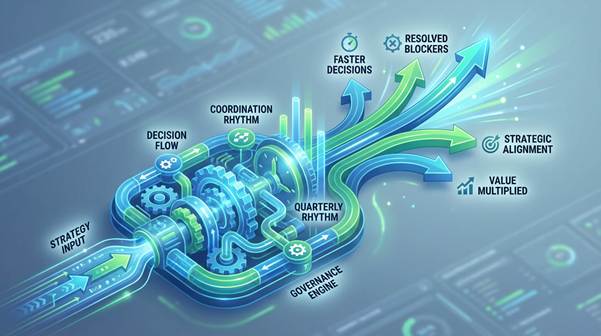
The AI Governance Operating Model
Structure: Four Governance Layers
Effective AI governance has four layers, each with distinct roles, meeting cadences, and decision rights.
Layer 1: Steering Committee (C-Suite)
Purpose: Monthly strategic decisions ensuring AI remains aligned with corporate strategy and delivers promised business value.
Composition: CEO (chair), CFO, COO, CTO, pillar owners from Week 1, potentially board member if AI is strategic priority.
Meeting cadence: Monthly, 90 minutes, structured agenda with pre-reads distributed 48 hours in advance.
Decision rights: Approve AI opportunity selection above $100K, allocate budget across AI initiatives, resolve cross-functional resource conflicts, make go/no-go decisions on pilot scaling, adjust strategic priorities based on results.
What they do NOT decide: Technical implementation choices, tactical resource allocation under $100K, day-to-day execution decisions, operational blockers that should be resolved lower.
Healthcare company example: Their steering committee met first Monday of each month. In Month 3 of order automation, steering committee reviewed pilot results showing 65% automation rate versus 70% target, approved $30K additional spend to improve model accuracy, decided to delay quality inspection AI by one month to focus resources on getting order automation to target. These decisions happened in one 90-minute meeting because decision rights were clear.
Layer 2: PMO (Program Management Office)
Purpose: Weekly tracking, blocker resolution, and reporting ensuring AI initiatives progress according to plan.
Composition: PMO Lead (owns the governance process), technical representative (usually Data Science Lead), business representative (from Operations or Product), executive sponsor from steering committee.
Meeting cadence: Weekly, 30 minutes, standing agenda reviewing all active AI initiatives.
Decision rights: Approve tactical resource allocation under $25K, resolve operational blockers within existing authority, escalate strategic issues to steering committee, coordinate dependencies between initiatives, approve minor timeline adjustments.
What they do NOT decide: Strategic AI opportunity selection, budget reallocation across pillars, go/no-go decisions on scaling, cross-functional resource conflicts requiring C-suite involvement.
Weekly PMO agenda (30 minutes):
-
- Minutes 0-15: Each AI initiative reports progress (2-3 minutes per initiative)
-
- What shipped this week
-
- Plans for next week
-
- Blockers needing resolution
-
- Key metrics update
-
- Minutes 0-15: Each AI initiative reports progress (2-3 minutes per initiative)
-
- Minutes 15-25: Blocker resolution
-
- PMO resolves what’s within their authority
-
- Escalates what requires steering committee
-
- Minutes 15-25: Blocker resolution
-
- Minutes 25-30: Dashboard review and action assignments
Healthcare company PMO: Met every Tuesday 9:00-9:30am. Attendance was mandatory, no rescheduling. In Week 8 of order automation, PMO identified that error rate had jumped from 0.8% to 1.5%, determined root cause was data quality issue in new supplier feed, assigned data engineer to fix within 48 hours, confirmed fix by Thursday. Rapid response prevented error rate from affecting pilot success criteria.
Layer 3: Department Owners
Purpose: Execute AI initiatives within their domain and report weekly on progress, blockers, and results.
Who they are: Department heads, pillar owners, functional leaders responsible for AI implementation in their area.
Meeting cadence: Weekly execution within their teams, weekly reporting to PMO.
Decision rights: Assign resources within their department to AI initiatives, make tactical execution choices, escalate blockers they cannot resolve, provide input on AI opportunity selection for their domain.
What they do NOT decide: Whether AI initiatives continue or stop (steering committee decision), cross-department resource allocation (PMO or steering committee), strategic priority changes (steering committee).
Healthcare company example: VP Operations owned order automation initiative. Weekly within Operations, VP ran 60-minute execution meetings with order processing team, AI development team, and process improvement team. Tracked progress, resolved department-level blockers, made tactical calls on implementation approach. Then reported to Tuesday PMO meeting with consolidated update. This kept operations team coordinated without requiring C-suite involvement in tactical decisions.
Layer 4: Working Groups
Purpose: Daily execution, surfacing issues as they emerge, delivering on AI initiative commitments.
Who they are: Cross-functional teams actually building and deploying AI, typically 5-8 people including data scientists, engineers, business analysts, process owners.
Meeting cadence: Daily standups (15 minutes), weekly sprint planning, ad-hoc as needed for specific issues.
Decision rights: Technical implementation choices within approved approach, daily task prioritization, immediate issue resolution, escalation of blockers to department owners.
What they do NOT decide: Strategic direction of AI initiative, budget allocation, timeline extensions, scope changes requiring additional resources.
Healthcare company working group for order automation: 7 people (2 data scientists, 2 integration engineers, 1 process analyst, 1 operations supervisor, 1 QA specialist). Met daily 8:30am for 15-minute standup, each person answered three questions: what I completed yesterday, what I’m working on today, what blockers I’m facing. Issues requiring department owner involvement got escalated same day, not sitting until next weekly PMO.
Process: Weekly, Monthly, Quarterly Cadences
Governance structure established, now define the operational cadences ensuring governance actually operates.
Weekly Cycle: Report → Consolidate → Resolve → Escalate → Dashboard
Monday-Tuesday: Report
-
- Working groups complete weekly status updates
-
- Department owners consolidate updates from their initiatives
-
- PMO receives all reports by Monday end of day
Tuesday: Consolidate & Resolve
-
- PMO reviews all reports during Tuesday meeting
-
- Identifies patterns, blockers, risks across initiatives
-
- Resolves what’s within PMO authority
-
- Escalates what requires steering committee
Tuesday-Wednesday: Escalate
-
- PMO documents escalation items for steering committee
-
- Provides context, options, recommendations
-
- Requests input from steering committee members offline if urgent
Thursday: Dashboard Update
-
- PMO updates centralized AI governance dashboard
-
- Ensures all stakeholders see current status
-
- Highlights items requiring steering committee decision
Healthcare company weekly cycle: By Tuesday 2pm every week, they knew status of all AI initiatives, which blockers were resolved, which needed escalation, and what would go to steering committee in upcoming monthly meeting. No surprises, no information gaps, rapid response to issues.
Monthly Cycle: Report → Review → Decide → Allocate → Communicate
Week 4 Monday: Report
-
- Department owners prepare comprehensive monthly updates
-
- Include KPI performance vs targets, budget burn vs plan, risk assessment, resource needs
-
- Submit to PMO 48 hours before steering committee
Week 4 Wednesday: Review
-
- Steering committee reviews pre-read materials
-
- PMO provides executive summary with key decisions needed
-
- Executives come prepared with questions and perspectives
Week 4 Friday: Decide
-
- Steering committee meets for 90-minute session
-
- Reviews AI portfolio health
-
- Makes strategic decisions: continue/pivot/kill initiatives, reallocate budget based on performance, adjust timelines or scope, approve new AI opportunities
-
- Documents decisions with clear owners and timelines
Following Monday: Allocate
-
- PMO translates steering committee decisions into action
-
- Updates budgets, resources, priorities
-
- Communicates changes to affected teams
Following Tuesday: Communicate
-
- Department owners communicate steering committee decisions to their teams
-
- Explain context, rationale, impacts
-
- Answer questions, address concerns
Healthcare company monthly cycle: First Friday of each month, steering committee made decisions. Following Monday PMO updated plans. Following Tuesday department owners communicated to teams. By second week of month, everyone knew what decisions were made and why, no confusion about priorities or resources.
Quarterly Cycle: Review → Board → Adjust → Refresh
Month 3 Week 2-3: Review
-
- PMO prepares comprehensive quarterly review
-
- Portfolio-level metrics: ROI achieved vs projected, strategic pillar impact, lessons learned
-
- Board presentation materials with exec summary
Month 3 Week 4: Board
-
- CEO presents AI portfolio to board
-
- Reviews strategic alignment, financial performance, risk factors
-
- Board provides guidance on strategic direction
Month 3 Week 4 Friday: Adjust
-
- Post-board meeting, steering committee adjusts strategy based on board input
-
- Updates AI opportunity pipeline, reprioritizes initiatives, adjusts governance approach if needed
Month 4 Week 1: Refresh
-
- PMO refreshes all governance documentation
-
- Updates dashboards, resets quarterly targets
-
- Begins new quarterly cycle
Healthcare company quarterly cycle: End of Quarter 1, they presented to board: order automation delivering $12 cost reduction (target $15 by Q2 end), on track for 12% margin goal, quality inspection AI delayed but not at risk. Board approved strategy, suggested exploring additional automation opportunities in logistics. Steering committee immediately added logistics assessment to Q2 priorities. Strategy stayed dynamic, responsive to results and board guidance.
Metrics: Strategic, Operational, Adoption
Governance processes defined, now establish the metrics governance tracks to ensure AI delivers value.
Strategic Metrics: Progress to Outcomes, ROI, Risk
These measure whether AI is delivering on strategic promises from Week 1.
Progress to Strategic Outcomes:
-
- For each strategic pillar, track KPI progress vs targets
-
- Healthcare example: Operating margin 10.8% (target 12% by year-end), cost per order $40 (target $35 by year-end), on-time delivery 91% (target 95%)
-
- Tracked monthly by steering committee
AI Initiative ROI:
-
- Investment: actual spend vs budget per AI initiative
-
- Return: measured business impact (cost savings, revenue increase, efficiency gains)
-
- ROI calculation: (Return – Investment) / Investment
-
- Healthcare example: Order automation invested $185K, delivered $12/order cost reduction × 50K orders/year = $600K annual savings, ROI = 224%
-
- Tracked monthly by steering committee, reported quarterly to board
Risk Indicators:
-
- Technical risks: model accuracy degradation, system downtime, integration failures
-
- Business risks: adoption below targets, customer impact, competitive response
-
- Operational risks: resource shortages, timeline delays, scope creep
-
- Healthcare example tracked: AI error rate (target <1%, actual 0.8%), user adoption rate (target 70%, actual 73%), integration uptime (target 99.5%, actual 99.7%)
-
- Tracked weekly by PMO, escalated to steering committee if thresholds breached
Operational Metrics: On Track/At Risk/Off Track, Blocker Time, Budget
These measure whether AI initiatives are executing according to plan.
Initiative Health Status:
-
- Green (on track): Hitting milestones, within budget, no major blockers
-
- Yellow (at risk): Minor delays or budget concerns, blockers being addressed
-
- Red (off track): Missing milestones, over budget, unresolved blockers
-
- Healthcare example: Order automation stayed green 10 of 12 weeks, yellow 2 weeks when error rate spiked, never red because issues got resolved rapidly
-
- Tracked weekly by PMO
Blocker Resolution Time:
-
- How long from blocker identification to resolution
-
- Target: <1 week for PMO-level blockers, <2 weeks for steering committee-level blockers
-
- Healthcare example: Average blocker resolution 4 days, escalation to steering committee happened twice, both resolved within 10 days
-
- Tracked weekly by PMO
Budget Burn Rate:
-
- Actual spend vs planned spend per initiative
-
- Variance analysis when >10% over or under budget
-
- Healthcare example: Order automation budgeted $200K, spent $185K, came in 7.5% under budget due to faster vendor training than expected
-
- Tracked weekly by PMO, reviewed monthly by steering committee
Adoption Metrics: Engagement, Adoption Rates, Productivity, Retention
These measure whether people are actually using AI and whether it’s delivering value to them.
User Engagement:
-
- Daily/weekly active users of AI tools
-
- Feature usage rates
-
- Time spent using AI vs manual processes
-
- Healthcare example: Order automation adoption target 70% of order volume by Month 6, achieved 73%, exceeded target
-
- Tracked weekly by department owners, reported to PMO
Adoption Rates by Segment:
-
- Breakdown by department, role, tenure, demographics
-
- Identify which groups adopt quickly vs slowly
-
- Healthcare example: Operations supervisors adopted at 95%, order entry specialists at 65%, identified gap requiring additional training for specialists
-
- Tracked monthly by department owners
Productivity Impact:
-
- Time savings per user
-
- Output increase (orders processed, reports generated, etc.)
-
- Error rate reduction
-
- Healthcare example: Order processing time reduced from 2.1 hours to 0.7 hours per order (67% reduction), error rate reduced from 8% to 0.8% (90% reduction)
-
- Tracked weekly during pilot, monthly in production
Employee Retention:
-
- Turnover rates among teams using AI
-
- Exit interview data on AI as factor in leaving
-
- Healthcare example: Operations team retention improved from 82% to 94% after automation because supervisors moved to higher-value exception handling work, found it more engaging
-
- Tracked quarterly by HR and department owners
The Deliverable: AI Governance Playbook
By end of Week 6, you produce an AI Governance Playbook documenting how governance actually operates in your organization.
The playbook includes:
Section 1: Governance Structure
-
- Four-layer model with roles and responsibilities
-
- RACI matrix from Week 3 operationalized
-
- Decision rights by governance layer
-
- Escalation paths when issues need higher authority
Section 2: Governance Processes
-
- Weekly cycle with timeline and activities
-
- Monthly cycle with decision-making approach
-
- Quarterly cycle with board involvement
-
- Templates for reports, dashboards, presentations
Section 3: Governance Metrics
-
- Strategic metrics dashboard
-
- Operational metrics dashboard
-
- Adoption metrics dashboard
-
- Thresholds triggering escalation
Section 4: Operating Rhythms
-
- Meeting schedules, agendas, pre-reads
-
- Decision-making protocols
-
- Communication cascades after decisions
-
- Continuous improvement mechanisms
This playbook goes to everyone involved in AI governance showing exactly how decisions get made, who makes them, when they happen, and how execution gets tracked.
Moving Forward
Week 6 completed the Strategic Foundation Framework. You have strategic foundation, readiness assessment, AI integration, customized execution, workforce preparation, and governance ensuring delivery.
Next steps: Execute. Use your governance model to ensure execution happens, track metrics showing progress, make decisions based on data not politics, resolve blockers rapidly, and adjust strategy as results emerge.
The six-week framework gave you everything needed to transform successfully. What separates successful companies from the 73% who fail isn’t better strategy or better technology, it’s better execution. Governance ensures execution happens.

Download: AI Governance Playbook Template
Get the templates to build your governance playbook, dashboards, and meeting agendas.
Week 6: The AI Governance Operating Model
Part of the Strategic Foundation Framework by EQ-AI Bridge Advisory LLC
Series Complete – All 6 Weeks
-
- Week 1: Building Corporate Strategy When None Exists
-
- Week 2: The Strategic Foundation Diagnostic
-
- Week 3: AI-Corporate Strategy Integration
-
- Week 4: The Gap-Based Execution Matrix
-
- Week 5: The Workforce Readiness Process
-
- Week 6: The AI Governance Operating Model


