


Introduction
You’ve completed Weeks 1, 2, and 3. You built a strategic foundation, measured your readiness, and integrated AI into your strategy. Or maybe you already had the foundation in place and verified it works. Either way, you scored yourself on the Strategic Readiness Diagnostic in Week 2.
Now comes the critical realization most consulting frameworks miss: one size does not fit all.
A company with no strategic foundation (scored 0-15) cannot execute the same roadmap as a company with a strong foundation (scored 36-50). The priorities are different, the focus areas are different, and the technology approach must be completely different.
Week 4 introduces the Gap-Based Execution Matrix, a framework that customizes your execution roadmap based on your Week 2 readiness score. This ensures you focus on what actually matters for your maturity level, not what works for someone else.
Note on overlap with previous weeks: Yes, this references concepts from Weeks 1-3, particularly your Week 2 readiness score. That’s intentional, Week 4 is about applying everything you’ve learned in a way that matches your organization’s actual readiness level.
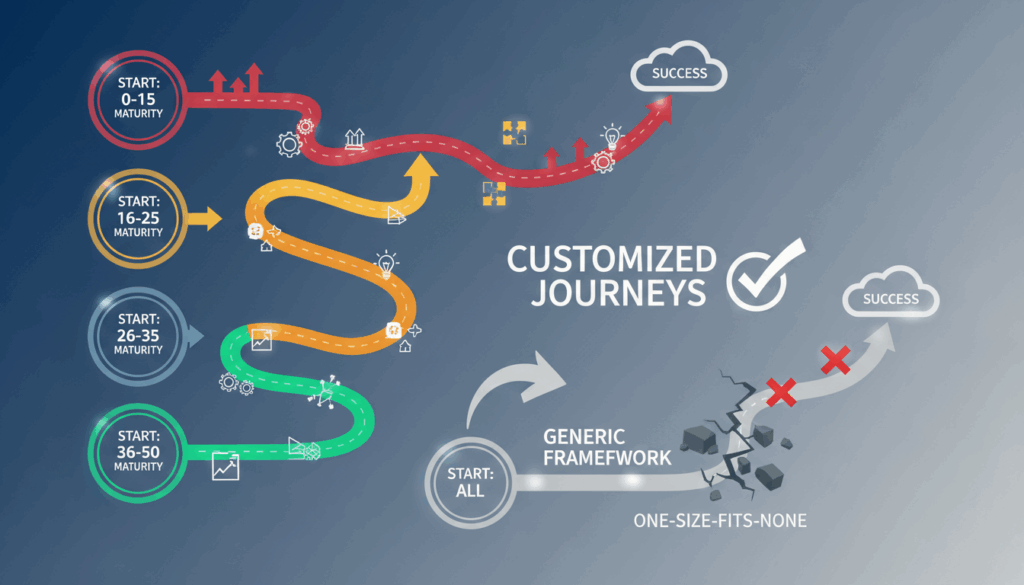
The Problem: One-Size-Fits-All Execution
Here’s what I see constantly in consulting engagements: Companies hire consultants or buy frameworks that promise transformation. The consultants deliver a comprehensive roadmap covering strategy, alignment, governance, AI integration, tool selection, and implementation.
The roadmap looks impressive, it’s thorough, it’s professionally designed. There’s only one problem: it assumes the company is ready for all of it simultaneously.
A company scoring 12 on strategic readiness (no foundation) gets the same roadmap as a company scoring 45 (strong foundation). Both are told to “build strategic pillars, cascade KPIs, establish governance, integrate AI, select tools, and deploy at scale.”
The company with no foundation drowns trying to do everything at once, the company with a strong foundation wastes time rebuilding what already works, and both fail because the roadmap didn’t match their maturity level.
The cost: Companies spend 6-12 months following generic roadmaps that don’t address their actual gaps. They build what they don’t need, skip what they do need, and wonder why transformation fails. Resources get wasted, teams get frustrated, and executives lose confidence in the process.
This week prevents that failure by customizing your execution roadmap to your specific readiness pattern.
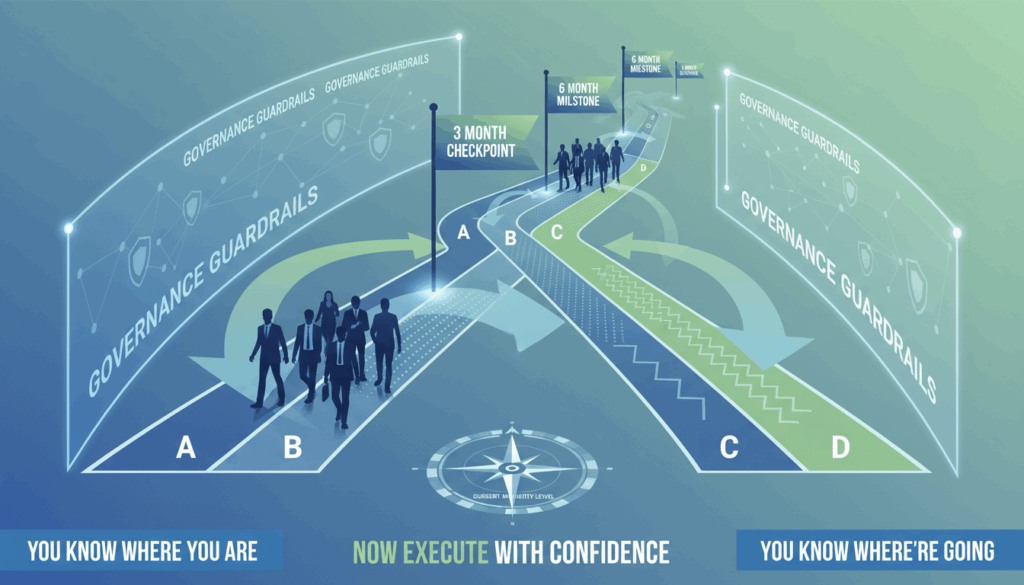
Key Principle: Customization Based on Maturity Level
Your Week 2 readiness score reveals your maturity pattern, and each pattern requires a different execution approach. Trying to execute at a maturity level you haven’t reached yet guarantees failure.
The principle is simple: Focus on closing your biggest gap first, then progress to the next maturity level.
A company with no corporate strategy (Pattern A) must build strategy before attempting AI integration. A company with strategy but no alignment (Pattern B) must cascade KPIs before selecting AI tools. A company with weak strategy (Pattern C) must strengthen competitive positioning before pursuing transformation. A company with a strong foundation (Pattern D) is ready for AI-business alignment and tool selection.
This isn’t about going slower, it’s about going in the right sequence. Attempting to skip maturity levels creates technical debt, organizational confusion, and failed initiatives. Companies that match execution to maturity level transform faster because they build on solid ground instead of sand.
The Four Execution Patterns
Based on your Week 2 Strategic Readiness score (0-50), you fall into one of four patterns. Each pattern has different priorities, focus areas, and technology approaches.
Pattern A (0-15): No Strategy
What this means: Your company lacks a strategic foundation entirely. There’s no clear corporate strategy, pillars aren’t defined, KPIs don’t cascade, governance doesn’t exist, and employees don’t know where the company is going.
Root cause: Leadership hasn’t aligned on strategy, or strategy exists only in documents nobody reads. The company operates reactively, responding to problems as they emerge without strategic direction guiding decisions.
Primary focus: Build corporate strategy first. Nothing else matters until you have a clear strategic direction. You cannot integrate AI into a strategy that doesn’t exist, you cannot cascade KPIs from undefined pillars, and you cannot establish governance for non-existent initiatives.
Technology approach: PAUSE all technology initiatives until strategy exists. This includes AI pilots, digital transformation programs, and tool evaluations. Technology without strategy wastes money and creates chaos. Once strategy is built, then evaluate where technology fits.
Week 4 execution roadmap for Pattern A:
Month 1: C-Suite Alignment
-
- Run Future Vision Workshop from Week 1 to align executives on strategy
-
- Create one-page vision document with explicit trade-offs
-
- Get C-suite signatures on Alignment Charter
-
- Communicate vision to organization
Month 2: Strategic Pillars Definition
-
- Define 3-5 strategic pillars with clear outcomes
-
- Assign pillar owners from C-suite
-
- Map current initiatives to pillars, kill what doesn’t align
-
- Create budget allocation across pillars
Month 3: Basic KPI Framework
-
- Define corporate-level KPIs tied to pillars
-
- Cascade to department level (don’t try individual level yet)
-
- Establish monthly review cadence for C-suite
-
- Build simple dashboard tracking pillar progress
Technology timeline: After Month 3, reassess readiness. If you’ve built a real strategy (not just documents), then move to Pattern B execution. If strategy is still weak, extend Pattern A focus before attempting technology integration.
Healthcare company example: Remember they scored 30 initially (Pattern C), but if they’d scored 12, they would have needed to spend 3 months on Pattern A work before even considering AI pilots. Their order automation project would have failed without a strategic foundation supporting it.
Pattern B (16-25): No Alignment
What this means: Your company has corporate strategy (or at least strategy documents exist), but strategy doesn’t cascade to execution. Departments have goals, but those goals don’t connect to corporate strategy. People work on initiatives, but can’t explain how their work supports strategic pillars.
Root cause: Strategy exists at the executive level but never cascaded properly. Communication broke down, governance doesn’t track alignment, and departments optimize locally instead of globally.
Primary focus: KPI cascading and PMO setup. Your strategy exists, now you need to connect it to actual work. This means cascading KPIs from corporate to department to team to individual, and establishing governance that tracks whether alignment is real or theater.
Technology approach: Enterprise integration audit. Before selecting new AI tools, understand what systems you already have, how they connect (or don’t), where data lives, and what integration challenges exist. Most companies discover they have technology they’re not using properly before they need new technology.
Week 4 execution roadmap for Pattern B:
Month 1: Complete KPI Cascade
-
- Map all department KPIs to strategic pillars
-
- Identify orphan KPIs that don’t support strategy, eliminate them
-
- Cascade department KPIs to team level
-
- Begin individual-level cascade for key roles
Month 2: PMO Structure Establishment
-
- Define PMO composition (lead, technical rep, business rep, exec sponsor)
-
- Establish weekly operational reviews for active initiatives
-
- Set up monthly strategic reviews with C-suite
-
- Document decision rights for common decisions
Month 3: Enterprise Integration Audit
-
- Inventory all current systems and tools
-
- Map data flows between systems
-
- Identify integration gaps causing alignment problems
-
- Assess whether current tools support strategic execution
Month 4: Governance Implementation
-
- Run first full cycle of weekly/monthly reviews
-
- Track which initiatives are aligned vs misaligned
-
- Make go/no-go decisions on misaligned initiatives
-
- Adjust KPIs based on what’s actually measurable
Technology timeline: After Month 4, if KPIs cascade properly and governance is functioning, move to Pattern C or D depending on strategy strength. If alignment is still weak, extend Pattern B focus before adding AI complexity.
What Pattern B companies should NOT do: Don’t start AI pilots yet. You’ll build AI that solves the wrong problems because you haven’t connected strategy to execution. The healthcare company would have built their churn prediction AI (not strategically aligned) instead of order automation (directly supporting operational excellence pillar) if they’d skipped this alignment work.
Pattern C (26-35): Weak Strategy
What this means: Your company has strategy and some alignment, but the strategy itself needs strengthening. Maybe competitive positioning is unclear, maybe strategic pillars aren’t differentiated enough, or maybe the strategy doesn’t account for market shifts that have occurred since it was created.
Root cause: Strategy was built once and never refreshed, or strategy was created without deep competitive analysis, or market conditions changed faster than strategy adapted. The foundation exists but it’s not strong enough to support transformation.
Primary focus: Competitive repositioning. Before investing in AI transformation, strengthen your strategic positioning. Understand where you win, where you lose, why customers choose you (or don’t), and what makes your strategy defensible. Weak strategy leads to AI that automates the wrong things or optimizes for the wrong outcomes.
Technology approach: Transformational tech assessment. You’re ready to evaluate AI, but need to assess which technologies actually transform your strategic positioning versus which are incremental improvements. This means understanding AI’s potential to create competitive moats, not just efficiency gains.
Week 4 execution roadmap for Pattern C:
Month 1: Competitive Analysis Deep Dive
-
- Conduct detailed competitive analysis (who wins where and why)
-
- Interview lost customers to understand why you lost
-
- Interview won customers to understand why you won
-
- Identify strategic strengths and weaknesses versus competition
Month 2: Strategic Repositioning
-
- Refine strategic pillars based on competitive insights
-
- Ensure pillars create defensible competitive advantages
-
- Update strategic priorities to address market realities
-
- Refresh pillar KPIs to measure competitive performance
Month 3: Transformational Tech Assessment
-
- Identify where AI creates competitive moats (not just cost savings)
-
- Evaluate which AI opportunities differentiate versus commoditize
-
- Assess build-vs-buy for strategic AI capabilities
-
- Map technology roadmap to strengthened strategy
Month 4: AI Integration Planning
-
- Return to Week 3 AI-Corporate Strategy Integration
-
- Remap AI opportunities against strengthened strategy
-
- Prioritize AI initiatives that enhance competitive position
-
- Build business cases for transformational AI investments
Technology timeline: After Month 4, move to Pattern D execution for AI implementation. Your strategy is now strong enough to guide AI investments that actually matter.
Healthcare company situation: They scored 30 initially, landing in Pattern C. If they’d discovered their operational excellence pillar wasn’t competitively differentiated (competitors also had low costs), they would have needed to strengthen strategy before pursuing AI automation. The AI would have optimized a strategy that doesn’t win in the market.
Pattern D (36-50): Strong Foundation
What this means: Your company has a strategic foundation, alignment is working, governance is functioning, and strategy is competitively sound. You’re ready for AI transformation because you have the maturity to execute it properly.
Root cause of success: You did the foundational work others skip. Strategy is clear, KPIs cascade, ownership is assigned, governance tracks progress, and employees understand their role. This didn’t happen by accident, it happened because you invested in boring fundamentals.
Primary focus: AI-business alignment. With a strong foundation in place, focus on ensuring every AI investment directly accelerates strategic pillars. This means rigorous opportunity assessment, clear ROI requirements, and disciplined project selection. Don’t let success make you sloppy about AI governance.
Technology approach: Tool selection and integration. You’re ready to evaluate AI vendors, select tools, and integrate them into operations. But maintain high standards: tools must integrate with existing systems, support strategic KPIs, fit within governance frameworks, and deliver measurable ROI within defined timelines.
Week 4 execution roadmap for Pattern D:
Month 1: AI Opportunity Finalization
-
- Complete Strategy Outcome Mapping from Week 3
-
- Score all AI opportunities using Week 3 assessment framework
-
- Select 2-3 Quick Wins for immediate implementation
-
- Identify 2-3 Strategic Bets for planning
Month 2: Vendor Evaluation & Selection
-
- Define requirements for AI tools (integration, security, scalability)
-
- Evaluate vendors against requirements
-
- Conduct POCs with top 2-3 vendors
-
- Select vendors for Quick Win initiatives
Month 3: Pilot Implementation
-
- Launch Quick Win AI pilots with clear success criteria
-
- Establish monitoring dashboards tracking pilot KPIs
-
- Run weekly PMO reviews tracking pilot progress
-
- Identify blockers and resolve them rapidly
Month 4: Scale Decisions
-
- Evaluate pilot results against success criteria
-
- Make go/no-go decisions on production deployment
-
- Plan scaling for successful pilots
-
- Document lessons learned for future AI initiatives
Month 5-6: Production Deployment & Strategic Bet Planning
-
- Deploy successful pilots to production
-
- Monitor production performance versus targets
-
- Begin detailed planning for Strategic Bet initiatives
-
- Allocate budget and resources for next wave
Technology timeline: Ongoing. With a strong foundation, you can maintain continuous AI deployment cycles. Complete pilots, deploy successful ones, start new pilots, repeat. Your governance ensures this doesn’t become chaos.
Healthcare company outcome: After strengthening foundation to 38, they executed Pattern D roadmap. Automated order entry (Quick Win) deployed in Month 4, delivered $15 cost reduction. Quality inspection automation (Strategic Bet) planned for Month 6. Foundation held during execution because they’d built it properly.
How to Use the Gap-Based Execution Matrix
Step 1: Know Your Pattern
-
- Retrieve your Week 2 Strategic Readiness score
-
- Identify which pattern you fall into (A, B, C, or D)
-
- Accept your current maturity level honestly (don’t pretend you’re Pattern D if you’re Pattern A)
Step 2: Follow Your Pattern’s Roadmap
-
- Use the specific execution roadmap for your pattern
-
- Don’t skip steps or try to accelerate into higher patterns
-
- Complete each month’s focus areas before progressing
-
- Reassess readiness quarterly using Week 2 diagnostic
Step 3: Progress Through Patterns Sequentially
-
- Pattern A companies build strategy, then reassess and move to Pattern B
-
- Pattern B companies build alignment, then reassess and move to Pattern C or D
-
- Pattern C companies strengthen strategy, then reassess and move to Pattern D
-
- Pattern D companies execute AI transformation, then maintain foundation
Step 4: Maintain Your Maturity Level
-
- Reaching Pattern D doesn’t mean you stay there automatically
-
- Organizations drift without continuous effort
-
- Run Week 2 diagnostic quarterly to catch regression early
-
- Invest in maintaining foundation even during transformation
Common mistake: Companies try to jump from Pattern A (0-15) directly to Pattern D (36-50) execution by hiring consultants who promise “complete transformation.” This fails. You cannot execute at Pattern D maturity when you’re at Pattern A foundation. Build maturity sequentially.
The Deliverable: Your Custom Execution Roadmap
By the end of Week 4, you produce a customized execution roadmap based on your maturity pattern.
The roadmap document includes:
Section 1: Current State Assessment
-
- Your Week 2 readiness score
-
- Which pattern you fall into (A, B, C, or D)
-
- Specific gaps preventing higher maturity
Section 2: Pattern-Specific Priorities
-
- Primary focus area for your pattern
-
- Technology approach appropriate for your maturity
-
- What to do and what NOT to do at your level
Section 3: Month-by-Month Execution Plan
-
- Detailed activities for each month
-
- Milestones indicating progress
-
- Decision points for pattern progression
-
- Resource requirements per phase
Section 4: Success Metrics
-
- How you’ll know you’re ready to progress to next pattern
-
- KPIs tracking execution progress
-
- Governance checkpoints ensuring you’re on track
Section 5: Risk Mitigation
-
- Common failure modes for your pattern
-
- Early warning signs you’re off track
-
- Corrective actions if execution falters
This roadmap goes to your executive team and board, proving you’re approaching transformation strategically based on organizational maturity, not following generic frameworks that don’t fit.
Moving Forward
Week 4 answered the critical question: what should you actually execute based on where you are right now?
You now have your customized execution roadmap matching your maturity pattern, clear priorities for the next 3-6 months, understanding when you’re ready for AI transformation, and governance ensuring you don’t regress during execution.
Next steps: Execute your pattern-specific roadmap. Don’t try to skip patterns, don’t attempt higher maturity execution than you’re ready for, and don’t forget to reassess quarterly. Organizations that match execution to maturity transform successfully, those that don’t end up as the 73% who fail.
For now, download your pattern template, build your custom roadmap, and begin execution at the right maturity level for your organization.
Download: Gap-Based Execution Templates
Get the pattern-specific templates to build your customized execution roadmap based on your Week 2 readiness score.
Week 4: The Gap-Based Execution Matrix
Part of the Strategic Foundation Framework by EQ-AI Bridge Advisory LLC
Next: Week 5 – Change Management & Adoption (Coming Next Week) Previous: Week 3 – AI-Corporate Strategy Integration


