


Introduction
Most business transformations don’t fail because of the technology; they fail because companies try to automate chaos. You can’t fix what you won’t acknowledge, you can’t measure improvement without a baseline, you can’t transform what you haven’t strategized.
I’ve watched the same pattern across corporate, and multinational environments. Company decides “we need this ” launches pilots, gets mediocre results, can’t scale, blames the technology and tries again later with different buzzwords.
The problem isn’t solutions or the tech, the problem is they skipped the foundation.

The Foundation Nobody Builds
Before you select AI tools, technology or hire data scientists, you need to answer five fundamental questions:
-
- Where are we actually? Not where you think you are, but where the data says you are. Most companies can’t honestly answer this because they’ve never documented the uncomfortable truths.
- Where are we going? Not vision statements nobody remembers, but specific targets your C-suite agrees on. Most companies have five competing visions from five executives.
- What will we focus on? Not everything that sounds important, but the 3-5 strategic pillars you’ll fund properly. Most companies say everything is a priority, which means nothing is.
- How do we measure success? Not vanity metrics, but KPIs that cascade from corporate goals to individual work so everyone knows what they’re accountable for.
- How do we stay on track? Not annual reviews where nothing changes, but governance that catches problems early and enables rapid course correction.
Answer those five questions properly, and transformation becomes possible. Skip them, and you’re building on sand.
Why read this? My Personal Take
This framework isn’t theoretical, it’s born from 15+ years watching the same patterns repeat across corporate, and multinational environments. Every failed transformation I’ve analysed, every “AI didn’t work” post-mortem, every stalled digital initiative, every expensive consultant engagement that went nowhere traces back to missing strategic foundation. I’ve been saying this to companies for years. Some executives listen, they build the foundation, even though it’s uncomfortable and unglamorous and their transformations work. Others don’t listen either due to hierarchy, mindset, arrogance, incompetence, whatever the blocker they skip straight to exciting technology decisions. They operate in chaos, try to automate chaos, wonder why chaos persists, then blame the technology or the people. It’s a shame when they don’t get it or choose to ignore it.
And here’s what happens in those companies: the culture becomes toxic. Finger-pointing, high turnover, blame culture. When there’s no strategic foundation, nobody knows what success looks like, so everyone protects themselves and blames others when things fail. Talented people leave and the ones who stay become cynical. It’s exhausting and soul-crushing to watch and to be a part of.
If you work in one of those environments, here’s my advice: move on. Don’t waste years in organizations that refuse to build strategic foundations and stay accountable. Use this framework to identify where your company is. If they’re operating in chaos, blame everyone but themselves, and won’t change, find a company that embraces this journey. Life’s too short to work in toxic environments watching preventable failures repeat.
I’m not preaching for you to read this guide and series, it’s up to you, but I can assure you, you’ll gain something from it. Whether you use it to transform your company or realize it’s time to move on, this framework gives you clarity on what matters.
The Five Components
This framework covers five critical components that build your strategic foundation:
-
- Current State Assessment – Document where you are, not where you pretend to be. The brutal honesty audit that forces uncomfortable truths to the surface.
- Future Vision Workshop – Force your C-suite to align on one direction instead of five competing strategies. Get executives to sign a one-page vision with explicit trade-offs.
- Strategic Pillars Definition – Define your 3-5 battlegrounds and do the math on whether you can afford them. Kill good projects to fund great ones.
- KPI Cascading – Connect corporate goals to individual work so everyone knows what success looks like for their role. Create line of sight from CEO to frontline.
- Communication & Governance – Build the structure that keeps strategy alive through execution. Establish meeting cadence, decision rights, and accountability mechanisms.
The Healthcare Company Story
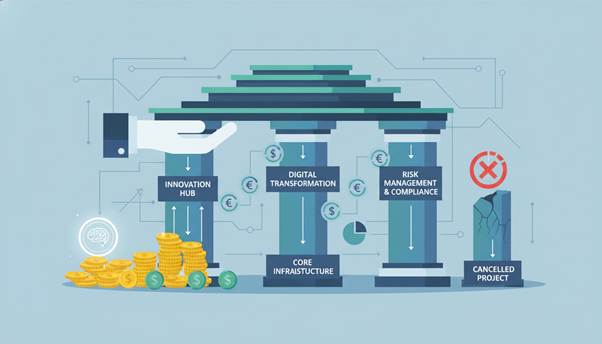
Throughout this guide, you’ll follow one healthcare company’s journey. They started where you might be growing revenue but destroying margins, top performers leaving, data quality terrible, 18 unfunded initiatives competing for resources. Leadership thought “AI will fix this.” it wouldn’t have. AI on that foundation would have been expensive failure. Instead, they built the strategic foundation first. The results: margins improved from 8% to 10.5%, top performer retention up from 78% to 94%, cost per order down from $47 to $38, customer churn reduced from 12% to 9%. The AI implementation they postponed? They launched it once the foundation was solid, and it worked.
That’s what the Strategic Foundation Framework enables, not theory, real transformation that survives reality.
One Warning
This work is uncomfortable. You’ll discover initiatives went nowhere, you’ll see departments optimizing for conflicting goals, you’ll realize your data is worse than you thought, you’ll have to kill good projects, and you’ll force conversations executives have been avoiding. This is why most organizations skip the foundation. Not because they don’t have time but because they don’t have courage. If you want comfortable, hire consultants who’ll create reports that get shelved. If you want transformation that works, prepare for brutal honesty and hard decisions.
Ready? Let’s build the foundation that makes everything else possible.
Template Package Available
This framework comes with 12 ready-to-use excel templates covering assessment, vision alignment, pillar planning, KPI cascading, and governance. Templates are available for download at the bottom of this guide.
Component One: Current State Assessment
The Problem Nobody Admits
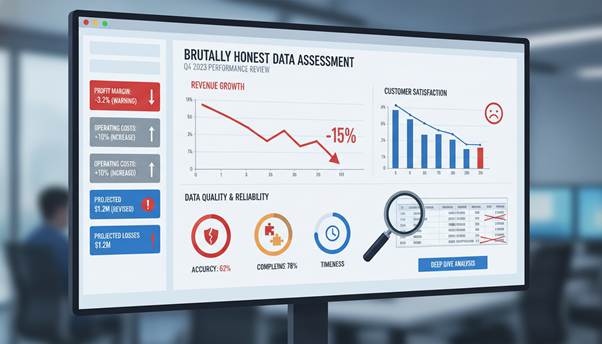
Most transformations fail because companies try to automate chaos. You can’t fix what you won’t acknowledge, you can’t measure improvement without a baseline and you can’t prioritize without knowing what matters. The ‘Current State Assessment’ isn’t about creating another consultant report, it’s about documenting the uncomfortable truths everyone whispers about, but no one writes down.
Skip this, and everything else you build collapses.
The Three Ways Companies Avoid This
The Expensive Theatre – Hire Big Four for $200K, six weeks of interviews, 180-page report. Recommendations: “implement best practices” and “drive cultural change.” Report gets shelved and nothing changes.
The Internal “We’ll Get to It” – Assign to busy manager, survey departments (23% response), create PowerPoint with arrows, present once. “We’ll revisit next quarter.” Never do.
The Arrogant Skip – “We already know our problems.” Jump to solutions. Solutions don’t address root causes nobody agreed on, initiative fails. Blame the technology and people. Repeat in 18 months.
Sound familiar?
What You’re Really Avoiding
Let’s be honest about why this gets skipped.
It’s uncomfortable. You’ll discover your strategic initiatives went nowhere. Departments optimize for different goals. Your data is worse than you thought.
It’s threatening. Someone’s pet project will be revealed as wasteful. Someone’s department will show up as the bottleneck.
It forces decisions. You’ll have to kill projects, reallocate resources, admit mistakes, have hard conversations.
This is why organizations skip it, not because they don’t have time but because they don’t have courage.
What An Honest Assessment Actually Reveals
When done properly, brutally honest, data-driven, comprehensive here’s what you discover.
The Revenue Story, You’re Not Telling Yourself – 80% of growth from one product line reaching saturation. “Strategic” new products lose money. Customer acquisition cost up 40% while lifetime value is flat. Growing revenue, destroying margins.You were celebrating but you should have been worried.
The Operational Reality Gap – Marketing generates thousands of leads. Sales says leads are garbage. Operations says Sales sells unprofitable things. Finance says nobody hits forecast. They’re all right. And they’re all optimizing locally while destroying value globally.
The Customer Truth Bomb – Your NPS is “good” because you only survey people who don’t churn. When you talk to customers who left, you learn what they really think. It’s rarely what your customer success team reports.
The People Problem Nobody Names – Your top performers in critical roles are 6-9 months from leaving. Your succession plan is fiction. Your “high potential” program identifies people leadership likes, not actual potential.
The Technology Debt You’re Ignoring – Paying for 47 licenses. Twelve are used and eighteen are duplicates. “Integrated systems” held together by manual Excel uploads and Steve in IT who’s retiring next year. Nobody documented anything.
The Six Dimensions That Matter
Most organizations only look at financial and operational. That’s why they miss everything important.
-
- Financial Reality – Where money comes from vs. where you think it comes from
- Operational Truth – Where work bottlenecks vs. what the flowchart says
- Market Position – Why you win and lose deals (not why you think you do)
- Customer Experience – What makes customers stay and leave (the real reasons)
- Workforce Reality – Who’s indispensable, why top performers leave, what culture rewards
- Technology & Data – What you’re paying for vs. using, where data is wrong, what will break
How To Actually Do This
Time Required: 5-7 business days, not 3-6 months
Who Does It: Your executives making decisions, not analysts making PowerPoints
Output: 15-20 pages that drive action, not 180 pages that get shelved
Pull The Real Numbers
- Financial data (3 years, segmented properly)
- Operational metrics (the ones people watch)
- Customer data (including who left)
- People data (engagement, retention, performance)
If you can’t pull this in two days, that’s your first finding: your data infrastructure is broken.
Talk To Actual Humans
- C-suite (individually, so they tell the truth)
- Department heads (where processes break)
- Frontline employees (where reality meets strategy)
- Customers (especially ones who almost left)
Structured interviews with tough questions. Document everything and look for patterns.
Force The Conversation Get leadership in a room, present findings, challenge assumptions, make people uncomfortable. Document agreements and disagreements.
Document Reality
- Where we are (not where we thought)
- What’s working (protect this)
- What’s broken (fix this)
- What’s at risk (monitor this)
- What matters most (prioritize this)
Fifteen pages maximum.
Common Mistakes That Kill This
Analysis Paralysis – “We need more data.” No, you need decisions. 80% confidence is enough.
Sugarcoating – “Good with opportunities for improvement” = “mediocre but afraid to say it.” Document actual problems.
Boiling The Ocean – Don’t assess 47 departments. Sample. Focus. Use 80/20 rule.
Stopping At Symptoms – Revenue down 15%. Why? Keep asking why until you hit root cause.
Creating Shelf-ware – No action plan, no owners, no consequences = no change.
Real Example: Mid-sized healthcare company. Growing 15% year-over-year. Wants AI for efficiency. The assessment revealed 80% of growth from one product facing competitive pressure, CAC up 60%, hidden by revenue growth, Top 5 performers all interviewing elsewhere, data so poor monthly revenue reporting took 12 days (and was wrong), 18 “strategic initiatives,” none funded properly, three departments bought incompatible CRMs independently amd Leadership: “We had no idea.” Me: “Yes, you did. You just hadn’t documented it.”
AI initiative postponed, fixed foundation first and twelve months later AI worked.
Why This Matters. Without this assessment your AI strategy is guessing, your transformation builds on sand, your initiatives address symptoms, not causes and your decisions are based on assumptions, not reality The assessment is uncomfortable. It surfaces failures, challenges assumptions and forces accountability. That’s exactly why it matters and why companies skip it and why transformations fail.
You can’t transform what you can’t see.
Component Two: Future Vision Workshop
The Problem with Vision Statements
Most companies have a vision statement. Nobody remembers it, fewer believe it and almost nobody uses it to make decisions. Here’s what happens… CEO wants to double revenue in three years, CFO wants to improve margins by 500 basis points, CTO wants to modernize the tech stack, CHRO wants to capture millennials, and the COO wants to cut costs by 30%. You just gave me five conflicting strategies. Can you double revenue and cut costs 30%? Can you improve margins and invest in tech? Pick one. This is why transformations fail or stall. Not lack of vision, but five competing visions forced into alignment.

What The Workshop Actually Does
This workshop is about getting your C-suite in a room and forcing the conversations they’ve been avoiding. Given where you are (from Current State Assessment), where can you realistically go?
Four questions matter.
-
- What does winning look like in 3-5 years? Be specific: what revenue, what margins, what market position?
- What are your non-negotiables – the things that must be true no matter what?
- Where do you disagree – which priorities conflict and what trade-offs are required?
- How will you know if you’re succeeding – what metrics tell you if you’re on track?
Most workshops skip the third question and fail. The conflicts don’t surface until six months into execution when nothing’s working.
The 4-Hour Alignment Session
Get your C-suite in a room. No phones. No interruptions.
Hour 1: Each executive presents their vision of success (15 minutes each). What they want to achieve, how they’ll measure it, what resources they need. Document everything. No debate yet.
Hour 2: Facilitator shows where visions align and where they conflict. Where resource requirements exceed budget by 40%. Where assumptions differ. This is uncomfortable. That’s the point. Surface conflicts now, not later.
Hour 3: Force trade-offs. If you can only fund three of five priorities, which ones? If growth and margins conflict, which wins? Use real budget numbers. No theoretical “we’ll find efficiencies.” Real choices with real consequences.
Hour 4: Build unified vision. Three to five strategic priorities maximum. Success metrics for each. Resources allocated. What you’re not doing (equally important). Every executive signs off literally.
The One-Page Vision
Everything must fit on one page. If it doesn’t fit, it’s not clear enough. Vision statement (2-3 sentences). Quantified 3–5-year targets. Three to five strategic priorities. Five to seven non-negotiables. Success metrics. And critically, what you’re not doing – the good ideas you’re saying no to. This goes on every wall. Gets referenced in every decision. If an initiative doesn’t support these priorities, it doesn’t get funded.
The Reality Check
Before finalizing, pressure test it. Do you have the budget? The capabilities? The time? What must you stop doing to fund this? Is this realistic given competition? Do customers want this? Can your culture support this change? If it doesn’t pass reality checks, revise it. Better realistic vision you achieve than aspirational vision that fails.
Real Example
The healthcare company’s workshop revealed conflicts: CEO wanted 20% growth, CFO wanted margin improvement, CTO wanted $15M tech modernization. They couldn’t afford all three.
The hard conversation: Pick two and do them adequately or pick one and do it well.
Their decision: Fix operational foundation first (enables everything else), then selective growth in high-margin products only. Tech modernization phased over three years instead of one.
Result: Clear priorities. Aligned resources. Twelve months later, foundation was solid enough for AI implementation. Without forcing this choice, they’d have underfunded everything and failed at all three.
What Success Looks Like
Unified vision (C-suite aligned), quantified targets (specific and measurable), three to five strategic priorities (funded properly), explicit trade-offs (what you’re not doing), success metrics (how you measure), signed commitment (creates accountability), one page (clear enough for everyone). Can’t check all boxes? You’re not done.
Why This Matters
Without aligned vision, everything else fails. Strategic Pillars need a vision to support, resources need direction to allocate toward, KPIs need targets to cascade from and governance needs something to govern. The vision workshop is where you either achieve genuine alignment or admit you’re not ready for transformation.
Component Three: Strategic Pillars
Strategy Without Budget Is Fiction
You’ve got your vision, C-suite is aligned and everyone’s excited, now comes the part where most strategies die: the math.
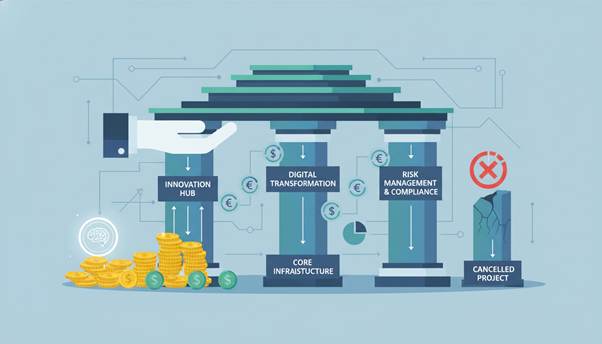
Strategic pillars are your three to five battlegrounds you must win to achieve your vision. They’re not departments, they’re not initiatives, they’re the major bets you’re making about where to channel resources to serve customers better than anyone else. Most companies define pillars, assign them to executives, and assume resources will materialize. Six months later, every pillar is underfunded, progress is slow, and leadership wonders why “we’re not executing.” You weren’t executing because you never actually funded execution.
What Strategic Pillars Actually Are
Think of pillars as the foundation supporting your vision. If vision is “where we’re going,” pillars are “the big moves required to get there.”
Take our healthcare company example. Their vision was to stabilize operations and grow selectively in high-margin products. That translated to three pillars:
-
- Operational Excellence meant fixing the broken foundation. Improve processes, implement proper systems, get data quality right. Cost: $8M over two years.
- Selective Growth meant doubling down on profitable product lines, exiting low-margin business. Investment required: $12M in sales and product.
- Talent Retention meant stopping the bleeding of top performers through competitive comp and career paths. Cost: $7M total.
Notice what’s missing? The full tech modernization ($15M), the new market expansion ($10M), and the innovation lab ($8M) that various executives wanted. Those didn’t make the cut because the company couldn’t afford everything.
The Questions That Define Your Pillars
Each pillar emerges from asking hard questions about your competitive reality. Where can you create advantage that competitors can’t easily copy? What capabilities must you build or acquire to serve customers better than anyone else? What’s performing badly and holding you back? Which opportunities are you missing that align with your vision? For the healthcare company, Operational Excellence addressed what was performing badly. Their Current State Assessment showed broken processes costing them millions. Selective Growth addressed the opportunity they were missing, focusing on what they were good at instead of trying to serve every customer segment. Talent Retention addressed a critical capability gap they were losing the people who knew how to execute. Each pillar needs a clear objective. Not vague aspirations like “improve operational efficiency” but specific outcomes. “Reduce order-to-delivery cycle time from 18 days to 10 days and cut operational costs by 15%.” That’s measurable, that’s actionable, that’s how you know if you’re winning your battleground.
The Budget Reality Check
Now comes the uncomfortable part. Add up what everything costs. The healthcare company did this math: $8M for operations, $12M for growth, $7M for talent. Total required: $27M over two years. Current discretionary budget available: $22M over two years. Gap: $5M short. This is the moment where most companies break the exercise. “We’ll find efficiencies” or “We’ll phase it” or “We’ll get board approval for more funding.” Maybe, but probably not. Better to make hard trade-offs now than pretend resources will magically appear.
The Portfolio Rationalization
Here’s where you kill things to fund strategy. Every company has projects consuming resources that don’t support the new strategic pillars. It’s time to stop them. The healthcare company had 18 “strategic initiatives” running. When they mapped each against the three pillars, they found six initiatives clearly supported the pillars (continue and properly fund these), nine didn’t support any pillar (kill these, recover $6M), and three were nice to have but not critical (pause these, recover $2M). Killing those 12 initiatives was politically painful. Each had an executive sponsor who believed in it. Each had a team working on it but they didn’t support the strategy, and the company couldn’t afford to do everything. The recovered $8M more than covered the $5M gap. They had $3M in additional capacity to invest in highest-priority initiatives within the pillars.
When You Can’t Fund Everything
Sometimes you can’t kill enough to close the gap. Then you need harder choices, score each pillar on impact (how much does this move the needle?), urgency (what happens if we delay?), and feasibility (can we pull this off?). High impact, high urgency, high feasibility gets funded first. High impact but low feasibility means maybe you need to build capability before attempting this. Low impact means why is this a strategic pillar at all? Sometimes you phase a pillar over more years. Full tech modernization becomes a three-year program instead of one year, with most critical systems first. Sometimes you reduce scope. Comprehensive process redesign becomes focusing on the three most critical processes first. The key is making these decisions explicitly, with eyes open, understanding trade-offs and not pretending you’ll do everything and then failing.
Real Example: Making The Hard Choice
The healthcare company faced a brutal decision. They needed to cut something. The CFO argued Talent Retention could be delayed “people will stay if we fix operations.” The CHRO pushed back with data from Current State Assessment showing their top five performers were already interviewing elsewhere. The CEO made the call. They reduced the scope of Selective Growth from entering three new customer segments to focusing on just one, the highest-margin segment. That freed up $4M. They also phased Operational Excellence differently, doing critical fixes in year one and broader improvements in year two. That created another $2M in year one breathing room. These weren’t easy decisions. The CMO was disappointed about the reduced growth scope, but the alternatives were worse – underfund everything and fail at all three, or delay talent investments and lose the people who could execute the strategy.
The Board Package
You need a document ready for board approval. It includes the vision and strategic pillars, detailed business case for each pillar showing investment and expected returns, portfolio rationalization showing what you’re stopping, resource allocation plan showing how money flows to each pillar, and risk assessment showing what could go wrong. The healthcare company’s board presentation was 25 slides. Not 100 slides, not 10 slides but just enough detail to show they’d done the work. The board approved it because it was a realistic plan with clear priorities, honest trade-offs, and accountability.
What Success Looks Like
You have three to five pillars you’re pursuing with clear objectives and success metrics for each. You know what each pillar costs and what returns you expect. You’ve killed or paused projects that don’t support strategy, you’ve closed the resource gap through real trade-offs, you have a board-ready package. Every pillar has an executive owner committed to delivering. If you can’t check those boxes, you don’t have a strategy yet. You have a draft.
The Hard Truth About Priorities
Real priorities mean saying no. No to good ideas that don’t fit. No to projects people are passionate about. No to initiatives that made sense last year but don’t support this year’s strategy. The healthcare company killed a product line one executive had championed for three years. It was his baby, and he believed in it. But it was low-margin, required resources they didn’t have, and didn’t support the selective growth pillar focused on high-margin products. It was a good product, but it just wasn’t strategic anymore. That’s the difference between having priorities and pretending to have priorities.
Why This Enables Execution
Strategic Pillars with real funding enable everything that follows. KPI Cascading only works if pillars are clear. Governance only works if you’re governing something specific. Without this step, you have vision without implementation, inspiration without action, slides without results. With this step, you have a realistic roadmap that honest people can execute because it’s grounded.
Component Four: KPI Cascading
The Problem with Corporate KPIs… most company have KPIs but most are useless.
Here’s what typically happens: leadership sets a corporate goal like “increase revenue 25% in three years.” Great, now explain how that translates to Maria in customer support, David in operations, or Jennifer in marketing. What should they prioritize? How do they know if they’re contributing? Nobody can explain it. The corporate KPI floats somewhere in the sky, disconnected from actual work. Maria keeps answering tickets, David keeps optimizing his processes and Jennifer keeps running campaigns. Revenue grows or doesn’t, and nobody can trace it back to individual decisions and actions. This is why companies wonder “why aren’t we making progress?” You’re not making progress because you never connected corporate goals to individual accountability.
What KPI Cascading Actually Does
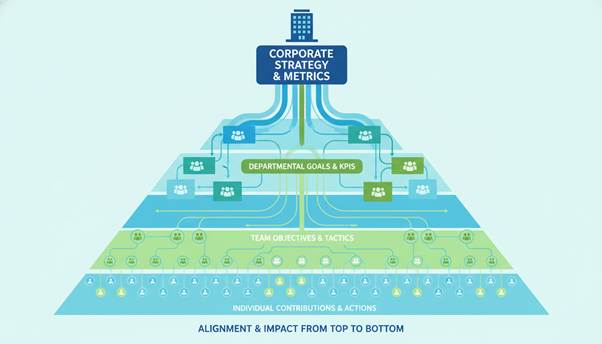
KPI Cascading means every corporate goal flows down through departments to teams to individuals. It creates a line of sight from CEO objectives to individual contributor work. When done right, everyone can answer: “Here’s how my work connects to company success.”Take our healthcare company example. Corporate goal was to improve margins from 8% to 12% over two years. Clear at the top but what does it mean for different departments? For operations, it meant reducing cost per order from $47 to $35 while maintaining quality. For sales, it meant shifting pipeline mix from 60% low-margin products to 60% high-margin products. For customer success, it meant reducing churn from 12% to 8% to keep more high-value customers. For product, it meant launching three new high-margin features while sunsetting two low-margin lines.
Each department KPI directly contributed to the 12% margin goal. Then each department cascaded their KPI down to teams and individuals. The customer success manager knew her goal was to reduce enterprise customer churn from 15% to 10%. The product manager knew his goal was to launch high-margin features by Q3. Everyone could connect their work to the corporate goal.
The Cascade Process
Start with your five to seven corporate KPIs tied to strategic pillars. If you have more, you’re not prioritizing. These should directly measure whether your pillars are succeeding. For each corporate KPI, identify which departments contribute. Some touch every department such as revenue growth involves sales, marketing, product, and customer success. Others are focused such as technology infrastructure primarily involves IT and operations. Then sit with each department head and ask: “Given this corporate goal, what must your department deliver?” Don’t let them pick vanity metrics, focus on outcomes, not “number of campaigns run” but “qualified leads generated.” Not “training hours delivered” but “skill proficiency achieved.” Each department KPI needs a clear owner, a specific target with deadline, measurement frequency, and direct connection to corporate goals. If you can’t explain how a department KPI rolls up to corporate, it’s the wrong metric. Once department KPIs are defined, repeat the process within each department. Each team gets KPIs supporting department goals. Everyone gets objectives supporting team goals. By the time you’re done, there’s a clear line from corporate strategy to individual performance reviews.
The Mistake Everyone Makes
The most common mistake is creating mathematically impossible cascades. Corporate goal is 25% revenue growth, so someone decides every department gets a 25% growth target. But marketing is at capacity, sales have coverage gaps, product development takes 18 months, and customer success is underwater with current customers. You just set every department up to fail because you didn’t think about how growth happens. Maybe marketing needs to generate 40% more qualified leads. Maybe sales need to improve close rate from 20% to 28%, not grow total pipeline. Maybe customer success needs to reduce churn by 3 percentage points to keep more revenue. Maybe product needs to launch one killer feature that enables upsells. Those different department goals might add up to 25% corporate growth but they’re realistic for each department’s situation. That’s the difference between cascading and fantasy.
Leading vs. Lagging Indicators
Every KPI cascade needs both types. Lagging indicators tell you if you succeeded (revenue is a lagging indicator, you see it after the fact). Leading indicators predict future success (they’re the things that drive lagging indicators). For the healthcare company’s margin improvement goal, the lagging indicator was actual margin percentage measured quarterly. But waiting until quarter-end to know if you’re on track is too late. So, they identified leading indicators: cost per order tracked weekly, sales pipeline mix tracked weekly, customer health scores tracked monthly. If cost per order started creeping up in week three, they knew margin would suffer and could intervene immediately. If sales pipeline was still 60% low-margin products in month two, they knew they needed to adjust sales incentives. Leading indicators gave them time to course correct. Most companies only measure lagging indicators and wonder why they can’t hit targets. By the time you see the problem, it’s too late to fix it for that period.
The Accountability Framework
KPIs without accountability are just numbers on a dashboard nobody acts on. The cascade must include who owns each KPI, what happens if they hit target, and what happens if they miss. Each department KPI needs a single owner. Not “sales and marketing jointly own pipeline.” One person owns it. If it’s pipeline, head of sales owns it. Marketing contributes, but sales own the outcome. This eliminates “we both thought the other person was handling it.” At the healthcare company, executive bonuses were tied 60% to corporate KPIs and 40% to their specific pillar KPIs. Department head bonuses were 40% corporate and 60% department. Individual contributors were tied primarily to individual and team objectives that rolled up to department KPIs.
This ensured everyone had skin in the game at both their level and corporate level. You can’t have marketing optimizing for lead volume if that creates pipeline quality problems for sales. Shared corporate metrics create shared accountability.
The Review Cadence
KPI cascades only work if you review them regularly. Not just annual performance reviews or quarterly business reviews. Regular, rhythmic reviews that catch problems early. The healthcare company implemented weekly operational reviews where each department head reported on their leading indicators. Any red flags got immediate attention. Monthly strategic reviews looked at lagging indicators and progress toward quarterly milestones. Quarterly board reviews assessed overall pillar performance and strategic adjustments needed. This cadence meant problems got caught and fixed in weeks, not quarters. When operations saw cost per order trending up in week two, they didn’t wait for month-end reporting. They investigated immediately, found a supplier issue, and resolved it. That’s the value of frequent review of leading indicators.
Real Example: The Cascade in Action
The healthcare company’s margin improvement KPI cascaded like this:
Corporate: Improve operating margin from 8% to 12% (lagging indicator, measured quarterly).
Operations Department: Reduce cost per order from $47 to $35 (leading indicator, measured weekly). This cascaded to the process improvement team (reduce rework from 12% to 6%) and procurement team (negotiate better supplier terms, save $2M annually).
Sales Department: Shift pipeline mix to 60% high-margin products (leading indicator, measured weekly). This cascaded to the enterprise sales team (focus 80% of time on high-margin deals) and account managers (identify upsell opportunities in existing accounts).
Customer Success: Reduce churn from 12% to 8% (leading indicator, measured monthly). This cascaded to CSMs (maintain customer health scores above 7/10 for all enterprise accounts) and support team (resolve issues in under 24 hours).
Every person in these departments could explain exactly how their daily work contributed to the corporate margin goal. That’s what successful cascading looks like.
What Success Looks Like
Everyone knows which KPIs they own and how they connect to corporate goals. Department KPIs are realistic and achievable, not just “mini-me” copies of corporate targets. You have both leading and lagging indicators so you can course-correct early. Accountability is clear with single owners for each KPI. Review cadence is established with weekly, monthly, and quarterly rhythms. Compensation is tied to KPIs at appropriate levels. If people can’t explain their line of sight to corporate goals, the cascade didn’t work.
Why This Enables Execution
Without KPI Cascading, you have strategy documents that nobody can execute because they don’t know what success looks like for their specific role. With KPI Cascading, you have clear targets at every level, leading indicators that enable course correction, and accountability that ensures people care about the outcomes. This is what connects your strategic pillars to actual daily work. This is what turns strategy into results.
Component Five: Communication & Governance
The Problem with Strategy Documents
Most strategic plans die within 90 days. Not because they’re bad plans, but because nobody built the governance structure to keep them alive.
Here’s what typically happens: Month 1 ends with an approved strategy, aligned executives, funded pillars, and cascaded KPIs. Everyone’s excited, then everyone goes back to their day jobs. Three months later, someone asks, “how’s that strategy going?” and nobody can answer because there’s no structure for tracking progress, making decisions, or course-correcting when reality hits. The strategy document sits on a shelf, Monday meetings become tactical fire drills and nobody’s accountable for strategic progress. Initiatives drift, priorities shift based on who yells loudest and a year later, leadership wonders why “we’re not executing our strategy.” You’re not executing because you never built governance to enforce execution.
What Governance Actually Does
Governance isn’t bureaucracy. It’s the framework that ensures strategy survives contact with reality. It answers three critical questions:
-
- Who makes what decisions?
- How often do we review progress
- What happens when we’re off track?
Think of governance as the GPS for your strategy. It doesn’t drive the car, but it tells you if you’re on route, warns you when you’ve taken a wrong turn, and suggests course corrections before you end up in the wrong city.
For our healthcare company, governance meant the difference between strategy and reality. They established clear decision rights, so people didn’t wait weeks for approval on time-sensitive issues. They implemented weekly operational reviews, so problems got caught and fixed fast. They created monthly strategic reviews where executives assessed pillar progress and adjusted resources. They scheduled quarterly board updates to maintain external accountability. Without this structure, their strategy would have died like every other strategy. Slowly starved by inattention and competing priorities.
The Meeting Cadence That Matters
Governance lives in meetings, but not the soul-crushing status update meetings everyone hates.
These are focused decision-making forums with clear agendas, specific outcomes, and accountability for follow-through. The healthcare company implemented three types of meetings. Weekly operational reviews focused on leading indicators and tactical execution. Each department head reported their KPIs, flagged any concerns, and requested support for blockers. These meetings lasted 30 minutes maximum because they focused on decisions, not discussion. If cost per order was trending up, the operations head didn’t present root cause analysis, they stated the problem, proposed a solution, and got approval or guidance to proceed. Monthly strategic reviews looked at lagging indicators and pillar progress. Each pillar owner presented progress against milestones, budget burn rate, risk factors emerging, and resource needs changing. The executive team made decisions about resource reallocation, initiative adjustments, and escalation of issues. These ran 90 minutes because they required deeper discussion about strategic trade-offs. Quarterly board reviews assessed overall strategy health. Were the pillars delivering expected outcomes? Had market conditions changed enough to warrant strategy adjustment? Did resource allocation need fundamental revision? These were full-day sessions because they involved external stakeholders and touched on fundamental strategic questions. This cadence meant problems got addressed at the right altitude. Tactical issues got fixed in days through weekly reviews, strategic concerns got resolved in weeks through monthly reviews and fundamental direction got validated or adjusted quarterly. Nothing festered for six months until it became a crisis.
The Decision Rights Framework
Governance without clear decision rights creates bottlenecks where everything escalates to the CEO.
Governance with clear decision rights empowers people to make the right calls quickly. The healthcare company mapped decision rights by dollar value and strategic impact. Spending under $10K with clear alignment to approved initiatives could be approved by department heads without escalation. Spending between $10K and $50K required VP approval. Spending over $50K required C-suite approval. Strategic pivots changes to pillar priorities, resource shifts between pillars, or adjustments to corporate KPIs required board notification at minimum, sometimes approval depending on magnitude. This framework eliminated two problems. First, it stopped executives from micromanaging tactical decisions that should be made three levels down. Second, it prevented junior managers from making strategic commitments the company couldn’t keep. Everyone knew the boundaries of their authority and when escalation was required. The framework also included escalation paths for when things went wrong. If a department head couldn’t resolve a blocker in their weekly review, it escalated to the monthly strategic review. If the executive team couldn’t resolve it there, it went to the quarterly board review. Nothing got stuck without a path forward.
The Communication Plan
Strategy dies in silence. If people don’t hear about strategic progress regularly, they assume nothing’s happening and stop caring.
The healthcare company built a communication rhythm matching their governance cadence. After weekly operational reviews, each department head sent a brief update to their teams highlighting wins, challenges, and priorities for the coming week. After monthly strategic reviews, the CEO sent a company-wide update on pillar progress, celebrating successes and explaining course corrections. After quarterly board reviews, the CFO updated all employees on overall strategic health and any major direction changes. This regular communication did three things. It kept strategy visible instead of letting it fade into background noise. It created accountability because people knew progress would be reported publicly. It built trust because leadership was transparent about both successes and struggles. The communication wasn’t spin. When operations missed their cost reduction target in Q2, the CEO didn’t sugarcoat it. He explained what went wrong, what they were doing differently, and what the new timeline was. That honesty built more credibility than pretending everything was on track.
Real Example: When Governance Caught A Problem
In month four, the healthcare company’s weekly operations review revealed cost per order had jumped 8% in two weeks. Without governance, this might have gone unnoticed until quarterly results showed missed margin targets. With governance, the operations head flagged it immediately. Investigation revealed a supplier had raised prices without notice. The procurement team was negotiating but needed executive support to threaten switching suppliers. In the monthly strategic review two weeks later, the CFO approved allocating $50K to qualify an alternate supplier as leverage in negotiations. By month five, they had negotiated better terms with the original supplier and qualified a backup option. Cost per order was back on track. The margin goal for the year was saved because governance caught the problem early and provided a path to fix it fast. That’s what good governance does. It creates early warning systems and rapid response mechanisms, so small problems don’t become strategic failures.
What Success Looks Like
You have a meeting cadence established with weekly operational, monthly strategic, and quarterly board reviews. Decision rights are documented showing who can approve what without escalation. Communication rhythm is defined for keeping everyone informed on progress. Accountability is clear with owners for each pillar and KPI. Course correction process is established for when things go off track. If people don’t know when strategy gets reviewed or who makes what decisions, governance doesn’t exist yet.
Conclusion
Why This Completes the Foundation
Governance is what connects all of this. Without it, you have a great plan that slowly dies through neglect. With it, you have a living strategy that adapts to reality while maintaining direction. Current State Assessment told you where you are, future Vision aligned you on where you’re going, Strategic Pillars defined what you’ll focus on, KPI Cascading connected strategy to individual work and Communication and Governance ensures it all happens. This is the foundation that makes AI transformation possible. Not because AI requires special governance, but because any transformation requires the discipline to stay focused when reality gets messy.
What Happens Next
You have strategy with foundation strong enough to support transformation. Now the real work begins. Execution over weeks, months, and years. The governance structure you built keeps you honest, the KPIs you cascaded keep you accountable, the communication rhythm keeps everyone aligned. Most companies never get here, they skip this and jump straight to AI pilots, wonder why nothing scales, blame the technology. You did the work, you built the foundation and now you can transform.
The Healthcare Company One Year Later
Remember where they started? Margin at 8%, top performers leaving, data quality terrible, 18 unfunded initiatives competing for resources. One year later margin improved to 10.5% and on track for 12%, top performer retention at 94%, up from 78%, cost per order down from $47 to $38, customer churn reduced from 12% to 9% and three high-margin product features launched on schedule. The AI implementation they postponed? They launched it in month 10 and it worked because the foundation was solid. Data quality was fixed, processes were documented, people knew their KPIs and governance ensured rapid iteration. None of that happens without this approach. None of it survives without governance. You’ve completed the Strategic Foundation Framework. Five components that most companies skip. You know where you are, your C-suite is aligned on one vision, you’ve defined 3-5 pillars and proven you can fund them, your KPIs cascade to individuals and your governance keeps strategy alive.
The Choice
Most companies will skip the foundation and jump to AI pilots. They’ll join the 70% that fail. Some will start building and get stuck but that’s progress. A few will complete the framework, and they’ll transform successfully because they built the foundation.
Which company are you or are you apart of?
Final Thought
You can’t automate chaos. You can’t transform what you can’t measure, and you can’t execute what you can’t govern.
Skip the foundation, build on sand but do it properly, transformation becomes real. Build the foundation, then build everything else on top of it.

Building Corporate Strategy When None Exists
Part of the Strategic Foundation Framework by EQ-AI Bridge Advisory
Get The Templates
This framework isn’t theoretical, it’s actionable. Download the complete template package to implement the Strategic Foundation Framework in your organization. 12 Excel templates mapped to the 5-component framework.
- Current State: Financial tracker, operational metrics, SWOT analysis, capability heat map, issues prioritization
- Future Vision: One-page vision document, C-suite alignment charter
- Strategic Pillars: Pillar canvas (5 worksheets), portfolio rationalization matrix
- KPI Cascading: Corporate-to-individual cascade map
- Governance: Decision rights matrix, meeting cadence template
Ready to Use:
- Pre-formatted with professional styling
- Built-in formulas and calculations
- Customizable for any organization size
- Battle-tested across industries


